Manufacturer · Fashion & Home Accessories

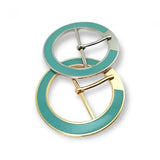





Metal rings for bags connect the handles and straps to the body of the bag and carry its full weight. To choose the right one, define the inner width to suit the strap, the shape to suit the function (most often a D-ring or round ring) and the material to suit the load. The finish should match the other metal accessories – zips, buckles and rivets.
Where metal rings are used on bags
A bag usually has several different rings, each with its own role:
- Handle-to-body connection. A small leather tab, sewn or riveted to the side panel, holds a ring through which the handle passes. D-rings or round rings are most common here.
- Points for a detachable strap. The two D-rings at the sides, onto which the snap hooks of the long shoulder strap clip.
- Length adjustment. A rectangular ring with a bar, or a slider combined with a ring.
- Decorative accents. Large round or oval rings as part of the design, for example on hobo bags or on the flap.
- Interior elements. Small rings for keys or for clipping on a purse.
How to choose the ring size
The size is defined by the inner width – the clear opening the strap passes through. It should equal the strap width plus an allowance for its thickness and the stitching. With thin webbing the allowance is minimal; with thick leather and a folded edge it is larger.
| Strap width | Recommended inner width | Typical use |
|---|---|---|
| about 15 mm | slightly above 15 mm | Mini bags, purses, evening bags |
| about 20 mm | slightly above 20 mm | Women's handbags, thin straps |
| about 25 mm | slightly above 25 mm | Shoulder bags, textile straps |
| about 30–40 mm | slightly above the width | Shopping and sports bags, wide straps |
| about 50 mm | slightly above 50 mm | Travel and tactical bags |
Do not forget the wire thickness either. If the ring is very thin compared with a wide leather strap, it visually "disappears" and concentrates the load along a narrow line, which can cut the material.
Material of metal rings for bags
Steel
Bent and welded steel wire is the classic choice for rings that carry weight. It must have a protective finish, because untreated steel corrodes.
Zinc alloy
Die-cast zinc alloy rings have no seam, a smooth surface and allow more complex profiles and a relief logo. That is why they are preferred for mid- and high-end fashion bags.
Brass
Brass is heavy, does not rust and looks naturally refined, especially with a polished or antique look. It is used on leather bags where the metal accessories should age beautifully.
Finish and colour
The most popular finishes are nickel, gold, light gold, antique brass, gunmetal and black, in gloss or matt. The rule is simple: all metal elements of one bag should be in the same finish and from the same batch. Combine the rings with buckles, snap hooks, zip pullers and metal tags in the same shade.
How to check the ring before a production run
- Pass the real strap through the ring, folded exactly as it will be sewn.
- Load the bag with a weight close to real use and leave it hanging.
- Check that the weld or casting point does not open and that the strap does not chafe on sharp edges.
- Inspect the finish after rubbing and contact with hands – especially with light-coloured leathers.
- Compare the colour with the zip and other metal accessories in daylight.
Attaching the ring to the bag
The ring is rarely attached directly to the bag body. Usually a small tab of leather or webbing passes through it and is sewn or riveted to the side panel. The tab length determines how freely the ring moves: if the tab is too short, the ring rubs against the seam and wears the material; if it is too long, the bag tilts. For heavier products the tab is reinforced with an insert and fixed with rivets as well as stitching.
Textile and leather bags
On textile bags made of canvas, denim or nylon, the straps are thinner and more flexible, so it is important that the ring has no sharp edges – they cut the fibres with constant movement. On leather bags the strap is thicker and stiffer, so the inner width needs a larger allowance and the ring profile should be fuller so it does not cut into the leather. With leather it is also worth checking how the finish behaves under rubbing, because the tanning agents in some leathers can react with metal.
Number of rings and symmetry
If the bag has a detachable strap, the rings on both sides must be placed at the same height and angle, otherwise the bag hangs crooked. In series production it is useful to make a template for the tab positions.
Common mistakes
- Choosing a ring "by eye" without measuring the finished, folded strap.
- An unwelded ring on a main handle.
- A ring that is too wide, in which the strap slides sideways and twists.
- A finish that has not been tested for rubbing against leather.
Metal rings for bags from Polkom
Polkom has been manufacturing and selling wholesale accessories for fashion, furniture, footwear, bags and leather goods for over 30 years. We have rings in a range of shapes, sizes and finishes, make custom designs and logo rings, and send samples quickly across the EU. Send the strap width, shape and finish via the inquiry form and you will receive a quote.