Manufacturer · Fashion & Home Accessories












Contents
No-sew buttons are fasteners that attach mechanically to the fabric – using a press, prong or screw – instead of needle and thread. The most well-known are metal jean buttons and snap buttons, but this group also includes screw buttons for repairs, caps that clip over existing buttons, and magnetic fasteners. They speed up production and offer greater strength under stress but require the right tools and matching fabric thickness.
Types of No-Sew Buttons
| Type | Attachment Method | Typical Use |
|---|---|---|
| Jean Button | prong on the back side, flattened onto the cap with a press | jeans, denim trousers, work pants, jackets |
| Snap Button | four parts connected through fabric with a press or machine | shirts, jackets, children’s clothing, bags |
| Screw Button | screw through fabric, fastened into the cap | home repairs, quick replacement |
| Button Cap | spring clip over an existing button | changing look without sewing |
| Magnetic Button | claws and washer or press fit | bags, wallets, flaps |
| Rivet | prong and cap pressed through fabric | reinforcing pockets (does not fasten) |
Metal Jean Button – How It Is Attached in Production
The jean button consists of two parts: a cap with a hollow front and a prong at the back. The prong is pushed through the waistband, inserted into the cap, and flattened by the press die. The result is a connection that cannot come undone and withstands strong tension.
- Choose the prong length according to the thickness of the waistband – it must pass through all layers and have enough material to flatten securely.
- Use a die designed for the specific button model. A mismatched die can crush the cap or fail to flatten the prong properly.
- Adjust the press force on a fabric sample and test the strength of the attachment.
- Check whether the button is meant to rotate or stay fixed, depending on the model.
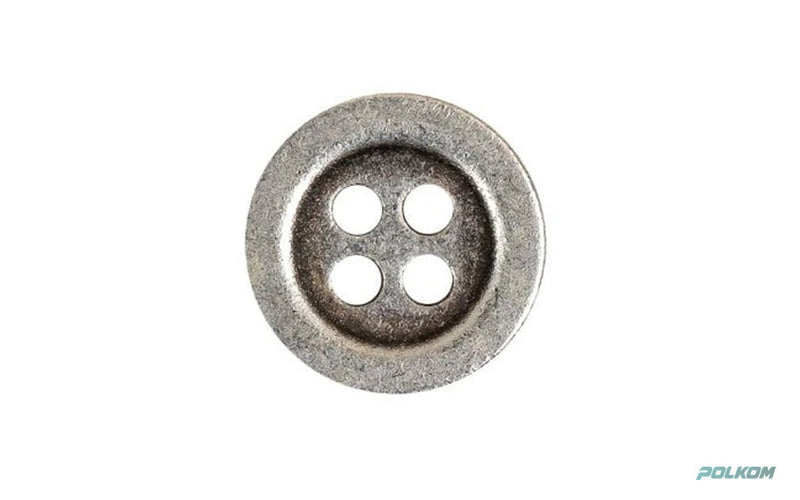
The metal jean button is available as classic coin style, open cap, rotating, and stainless steel – see jean buttons. The cap can carry an embossed brand logo.
Snap Buttons – Attachment
Snap buttons are attached using a hand press, lever press or automatic machine. Each system (chico with teeth, 54, 61, etc.) has its own dies. The main rules for snap button attachment are:
- choose the system according to the fabric – chico for knits and thin materials, 61 system for denim, leather and heavy fabrics;
- reinforce the area with an insert or double fabric if the material is thin;
- do not mix parts from different systems – male and female parts must be from the same system;
- perform tests for opening force and tear resistance, especially for children’s clothing.
The full range of systems and sizes is available in the snap buttons category.
No-Sew Buttons for Home Repairs
When a jean button falls off, a press is rarely available at home. That is why screw buttons are sold: a threaded prong passes through the hole in the waistband and screws into the cap with a small screwdriver. They are convenient, quick and require no special tools but have limitations:
- the screw can loosen with frequent use, so periodic tightening is recommended;
- the cap is usually standard and may not match the original brand design;
- if the hole in the waistband is torn, it should first be reinforced with a patch.
For temporary style changes – for example, a more elegant button on a jacket – button caps are used, which snap over the existing button.
Advantages for Production
- Speed. Pressing takes seconds and does not depend on the skill of the sewer.
- Uniformity. With proper setup, every button is attached identically.
- Strength. No thread that can wear out or break; jean buttons and snap buttons withstand greater stress than sewn buttons.
- Fewer operations. No buttonholes are needed for snap buttons and magnetic fasteners.
- Branding. The cap provides a good surface for logos.
When Sewing Is the Better Choice
No-sew buttons are not universal. Sewn buttons are better when:
- The fabric is delicate. Chiffon, silk and fine knits tear around prongs or teeth.
- The button is made of natural material. Corozo, horn, mother-of-pearl and wood are not pressed – they are sewn.
- The garment is classic. High-end coats, suits and shirts are expected to have sewn buttons and buttonholes.
- Easy replacement is needed. Sewn buttons can be replaced with needle and thread, while pressed buttons require tools and may leave holes.
- There is no suitable equipment. A small atelier without a press and dies will have more rejects than benefits.
If you want the look of a sewn button without visible stitching, consider sew-on snap buttons – they are sewn but fasten with a click.
Common Mistakes
- prong too short for a thick waistband – the button pops off after a few uses;
- prong too long for thin fabric – the flattened end scratches the skin;
- mixing parts from different snap button systems;
- attaching without reinforcement on a single thin fabric layer;
- attaching too close to the edge or seam – the metal lacks enough fabric to grip and tears the material;
- no testing after washing – some coatings and fabrics react differently after the first wash, so pull tests should be repeated on washed samples.
No-Sew Buttons from the Manufacturer
Polkom is a manufacturer of accessories for fashion, footwear and bags, as well as perfume and cosmetic packaging and furniture accessories, with over 30 years of experience and headquarters in Sofia. We produce jean buttons, snap buttons, rivets and caps with logos, in nickel free coatings and with OEKO-TEX® certification. Explore the full range in the buttons category. Send your fabric and model in a request for quote – we will recommend the best system, prong length and samples for testing.
Share this article