Manufacturer · Fashion & Home Accessories











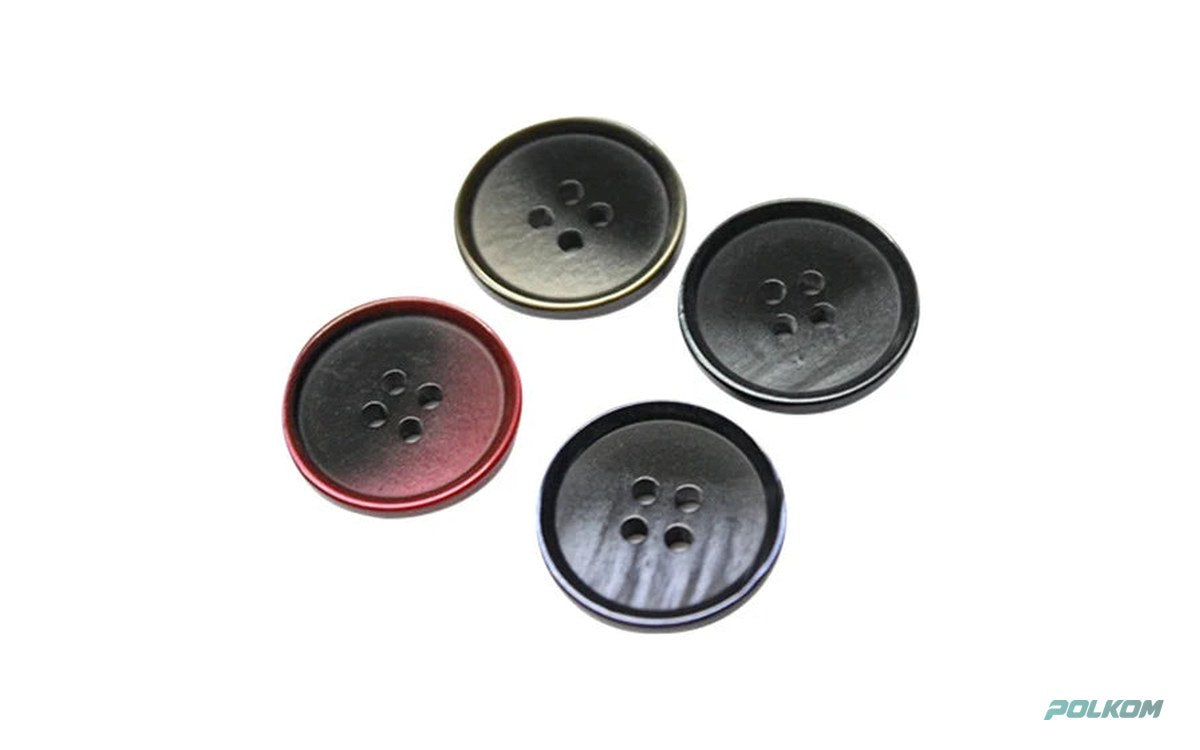
Polyester buttons with marble, stone and mother-of-pearl effects are created during the resin casting process: pearlescent pigments provide the mother-of-pearl shimmer, partial mixing of two or more colours forms marble veins, and opaque pigments, particles and tumbling produce the stone look. The result is lighter, more affordable and more uniform than natural materials, with colours matched to fabric samples.
How polyester buttons with effects are made
Polyester is a liquid resin that hardens after adding a catalyst. There are two main casting methods:
- Flat sheet – resin is poured into a rotating drum forming a sheet from which blanks are cut. This method is mainly used for mother-of-pearl and uniform effects.
- Rod – resin is cast as a rod and sliced into discs. This allows multicoloured veins and gradients, typical for imitation horn buttons.
The blanks are then turned on a lathe to shape the profile, edge and holes, followed by polishing or matt finishing. The effect is embedded in the raw material; finishing only enhances it.
Mother-of-pearl effect
The mother-of-pearl effect is achieved with pearlescent pigments – fine flakes that reflect light in layers. During tumbling, centrifugal force aligns the flakes in one direction, giving the finished button its characteristic soft shimmer that changes with rotation. The more aligned the flakes, the deeper the shine.
Compared to natural mother-of-pearl, polyester buttons are lighter, warmer to the touch and have a more uniform shine. Natural mother-of-pearl has a unique iridescent play of colours and feels cold and heavy in hand. For premium shirts and blouses, see mother-of-pearl buttons; for mass production, mother-of-pearl polyester offers a very close look at a more accessible price and consistent appearance across thousands of pieces.
Marble effect
Marble is created when two or more coloured resins are only partially mixed before casting. The veins form randomly, so each button has a unique pattern – just like natural stone. The contrast between colours defines the character: white with fine grey veins looks classic, while dark green with black is dramatic.
It is important to note that complete uniformity is impossible with the marble effect. If your brand requires identical buttons on one garment, you should agree on an acceptable range of patterns and approve a sample batch of several buttons rather than just one.
Stone effect
The stone effect is usually matt and dense. It is achieved with opaque pigments, fine particles or speckles in the mass, and the surface is tumbled or treated to lose plastic shine. Typical looks include granite, sandstone, terrazzo and slate. Stone-effect buttons look natural and “heavy” but weigh as much as regular polyester buttons – an advantage for coats and knits where real stone would be impractical.
Comparison with natural materials
| Feature | Polyester with Effect | Natural Material |
|---|---|---|
| Weight | Light | Heavier (mother-of-pearl, stone) or similar (corozo) |
| Touch | Warm, smooth | Mother-of-pearl and stone feel cold |
| Uniformity | Controllable, except marble | Each button is unique |
| Colour | Matched to fabric sample, almost any | Limited by nature or dyeing |
| Brittleness | Good durability | Mother-of-pearl can chip at edges |
| Price | More affordable | Higher, depends on raw material |
If you want natural materials with an organic look, see corozo buttons; for shimmering veins in polyester, see imitation horn buttons.
Pearl and decorative buttons for garments
Pearl buttons – spherical or hemispherical with a pearly sheen – are also made from polyester or plastic with a pearlescent coating. They are popular for blouses, dresses, knitted cardigans and evening wear. Decorative garment buttons often combine effects: marble body with polished edge, mother-of-pearl face with matt back, or stone with engraved logo.
Which effect suits which fabric
- Mother-of-pearl – shirts, blouses, silk dresses, satin and fine cotton; light and pastel tones.
- Marble – wool coats, jackets, knitwear and autumn collections, especially in green, brown, grey and burgundy.
- Stone – knits, linen, coarse woven fabrics, minimalist and “natural” collections.
- Combined effects – evening wear and accent buttons where the button is part of the design.
A good rule is that the busier the fabric pattern, the calmer the button effect should be. A marble button on a patterned fabric usually gets lost, while on a solid wool it becomes a key garment detail.
How to order buttons with effects
- Send a fabric sample or Pantone code for the base colour.
- Describe the effect: mother-of-pearl, marble, stone, gradient; attach a reference photo.
- Specify size in lignes, shape, number of holes or shank.
- Choose surface finish – gloss, semi-matt or matt.
- For marble, agree on acceptable pattern variation.
- Approve a sample batch with several buttons, not just one.
Care instructions
Buttons with effects are maintained like regular polyester buttons: they withstand machine washing and standard dry cleaning but should not be ironed directly with a very hot iron. The pearlescent coating on some spherical models is more sensitive to friction – check the sample if the garment is washed frequently.
You can find the full range of effects and colours in the polyester buttons category.
Polkom – Manufacturer of Polyester Buttons with Effects
Polkom is a manufacturer of accessories for fashion, footwear and bags, as well as for perfumes, cosmetics, packaging and furniture, based in Sofia with over 30 years of experience. We produce polyester buttons with mother-of-pearl, marble and stone effects in colours matched to your sample, including engraved logos. All products are OEKO-TEX® certified. Send your reference via the contact form to request samples.