Manufacturer · Fashion & Home Accessories











Contents
Rivets for fabric are small metal parts that join several layers of fabric, tape or leather and serve as decoration at the same time. The main types are tubular (hollow) rivets, double cap rivets with a cap on both sides, and decorative rivets. The right rivet is chosen by the thickness of the material: the post should be about 1–2 mm longer than the total thickness of the layers so that it sets reliably.
What are rivets for textiles
A rivet is a mechanical joint without a seam. It consists of a post that passes through the material and a head or cap that stays on top. When it is set, the end of the post is flattened or pushed into the counterpart, and the joint becomes permanent. In textiles, rivets are used where a seam would come apart or where a visible metal accent is wanted: straps, handles, pockets, shoulder straps, belts, leather labels.
Textile rivet, jeans rivet or eyelet – in brief
| Part | Main function | Hole in the centre | Typical position |
|---|---|---|---|
| Textile rivet | joins layers and decorates | small on tubular rivets, otherwise none | straps, handles, labels, belts |
| Jeans rivet | reinforces stress points of the garment | none | pocket corners on jeans, jackets |
| Eyelet | forms and protects a hole | yes, functional | holes for cords and laces |
If you need a hole for a cord to pass through, choose eyelets. If you are looking for the part for the pocket corners of jeans, those are jeans rivets.
Types of rivets for textiles and fabric
Tubular rivets
The post is hollow, and when set its end curls outwards like a flower. Tubular rivets are light, quick to set and suitable for straps, tapes, gloves and thin leather. The end remains visible at the back, so they are used where the reverse side is not on show.
Double cap rivets
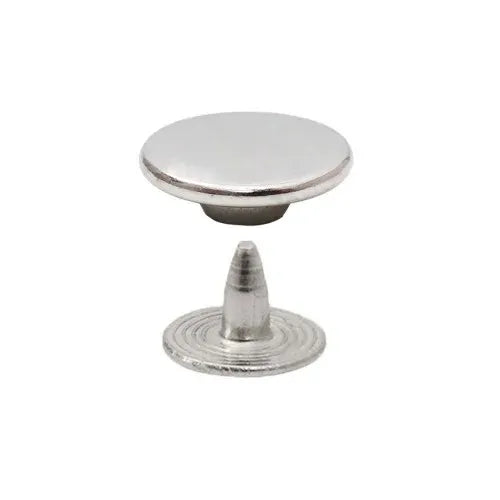
They consist of two parts – a cap with a post and a counterpart with a smooth cap. With a blow or pressure the two parts are pushed into each other, and the product looks clean on both sides. This is the most widely used rivet for bags, belts, straps and leather labels on denim.
Decorative rivets and caps
The cap can be domed, flat, pyramid-shaped, engraved or set with a decorative stone. Decorative rivets are arranged in rows on belts, jackets, shoes and bags and give a distinctive rock or vintage look.
Rivets with logo
The cap is a convenient place for the brand's mark. The logo can be raised, debossed or engraved and is made in the same finish as the other metal accessories of the product.
Sizes of rivets for textiles
When choosing the size, two parameters are considered: the cap diameter, which determines the look, and the post length, which determines whether the rivet will hold. The safest method is to press together all the layers to be joined and measure their total thickness.
| Material | Example | Post recommendation |
|---|---|---|
| Thin layers | tape on cotton fabric, thin leather | short post |
| Medium thickness | two layers of denim, leather label on denim | medium post |
| Thick layers | leather belt, strap of dense webbing, multi-layer handles | long post |
The general rule is that the post should be about 1–2 mm longer than the measured thickness. A post that is too short does not set and the rivet falls out, while one that is too long bends sideways and the cap stays tilted.
How to set rivets in fabric
- Mark the position and check that the rivet does not fall on a seam or another metal part.
- Punch a hole with a punch or hole cutter matching the post diameter – the hole must not be larger.
- Pass the post through from the inside out, or as the rivet type requires, and place the cap on top.
- Place the product on the anvil or die with the right profile so that the cap is not crushed.
- Set the rivet with a blow of the tool or with the press – in one confident movement.
- Check that the rivet does not turn and that the cap is parallel to the material.
Setting tools
- hand kit – punch, anvil and setter for striking with a hammer; suitable for samples and small batches;
- lever hand press – with dies for the specific size, gives even pressure and a consistent result;
- automatic press – for series production, with part feeding and consistent quality.
The die must always match the size and profile of the cap. An unsuitable die scratches the finish and deforms the head.
When choosing between hand and machine setting, volume and consistency decide. For a few dozen products a hand kit is enough, but the force of the blow varies and some rivets stay looser. In series production a press gives the same pressure to every rivet, fewer rejects and faster work. If you are just starting a production run, ask for rivet samples together with information about the matching die so that you can prepare the machine in advance.
Common mistakes
- a hole larger than the post – the rivet turns and works loose;
- setting in a very loosely woven fabric without reinforcement – the rivet pulls out under load;
- mixing parts from different batches;
- setting without a test on the real material.
For thin and delicate fabrics where a rivet is too heavy, see also the snap fasteners – they are also set with a press but are used for fastening.
Rivets for textiles from Polkom
Polkom is a manufacturer of accessories for fashion, shoes and bags with over 30 years of experience. In the rivets category you will find models for denim, jackets, belts, bags and leather goods, in various finishes and with a custom logo. All metal finishes are nickel free, and the products are OEKO-TEX® certified. Minimum quantities depend on the article. Send the material thickness, the desired finish and your logo via the contact page – you will receive a sample for testing.
Share this article