 Manufacturer · Fashion & Home Accessories











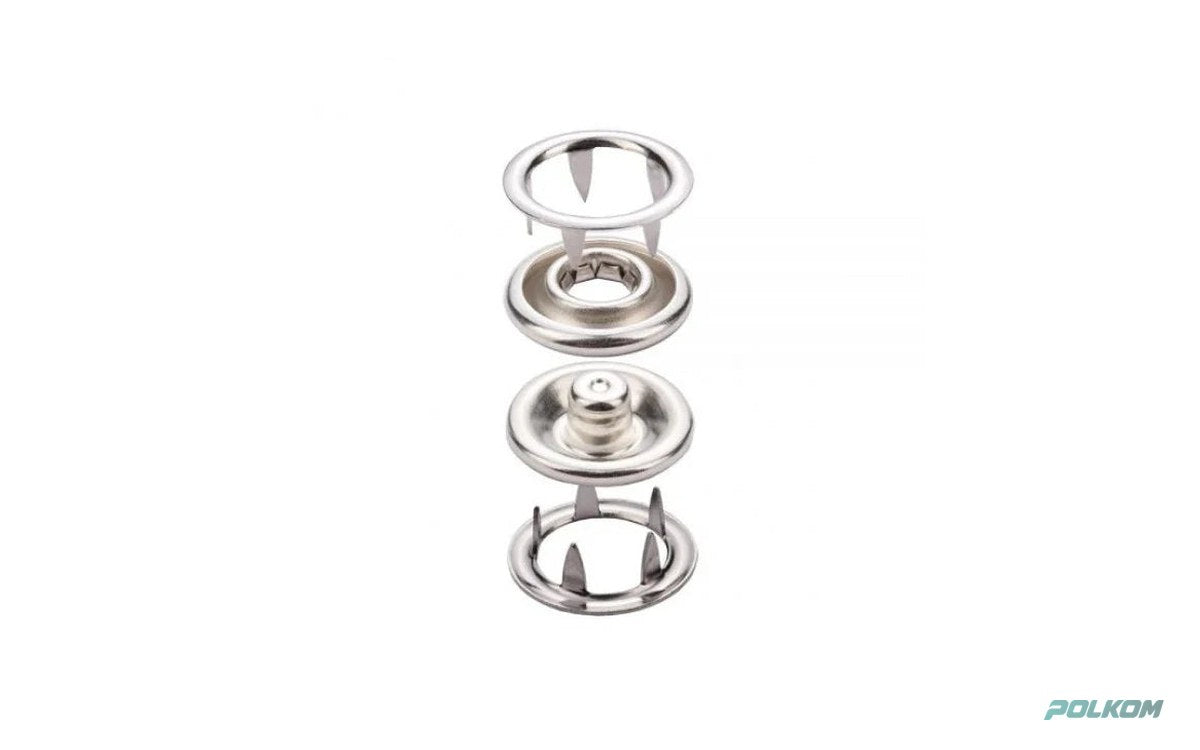
The length of the rivet post, prongs or tube of a snap button must match the fabric thickness at the setting point: short prongs or a short base for thin fabrics, long ones for dense and multi-layer areas. If the element is too short, the snap does not grip and pulls out; if it is too long, it bends, puckers the fabric and does not sit firmly. That is why, when ordering, you should state not only the cap diameter but also the fabric thickness – including all the layers under the snap.
Which element passes through the fabric
In the different systems a different part passes through the fabric – so “length” means different things:
- Prong snaps (with prongs) – the prongs of the top part and of the bottom ring pass through the fabric without cutting it.
- 54 and 61 systems – the tube of the bottom part (the post base) passes through the fabric and is rolled into the cap or the stud.
- Special systems with a rivet post – the bottom part is a rivet post (aluminium on some styles), suitable for leather and dense materials.
- Screw style – the stud is screwed into a hard base, with a short or long screw.
- Sew-on styles – have no element passing through the fabric; they are sewn on through the holes.
Post length and fabric thickness: styles with long and special elements
The Polkom catalogue explicitly states which styles have a version with long prongs, a rivet post or a screw. The table brings them together in one place.
| Code | Style | Element | Sizes (mm) | When it is used |
|---|---|---|---|---|
| PR-10 | Open ring | standard or long prongs – depending on fabric thickness | 6.8; 7.2; 7.8; 8.2; 9.5; 10.5; 11.5; 12.5; 15; 17; 21 | shirts, bodysuits, knitwear, denim shirts, children’s clothing |
| PR-11 | Open ring with long prongs | long prongs, grip thicker layers | 6.8; 7.8; 9.5; 10.5; 11.5; 15 | denser knitwear, multi-layer areas, workwear |
| PR-20 | Closed metal cap | also with long prongs for dense fabrics | 7.5; 8.5; 9; 10; 11.5; 12; 12.5; 16; 18; 22 | shirts, bodysuits, knitwear, children’s clothing, jackets |
| PR-40 | Mother-of-pearl cap | also with long prongs | 7.5; 8.5; 10; 10.5; 11.5; 12; 12.5; 15; 17; 21 | shirts, bodysuits, knitwear, denim shirts, babywear |
| S54-50 | 54 Alfa | caps: standard, long, flat and coin type | 12.5; 14; 15; 17; 20 | jackets, denim jackets, trench coats, coats – heavy fabrics |
| SP-30 | With rivet post and 54 cap | the bottom part is a rivet post | 10.5 – 30 | coats, trench coats, leather goods |
| SP-40 | Heavy-duty system with aluminium rivet post | aluminium rivet post; mini with 54 cap, large with 61 cap | 13; 13.3; 13.5 | jackets, denim jackets, trench coats, coats |
| SP-60 | With coin-type prong cap and rivet post | prongs and rivet post | on request | jackets, denim jackets, trench coats, coats |
| H61-70 | 61 with screw | stud with short or long screw | 15 | hard bases – wood, plastic; tarpaulins, covers, upholstery |
The exact element length for each version is confirmed on request and after a trial setting on your fabric – not “blindly” from a table.

How to determine the thickness at the setting point
The mistake is most often not in the snap but in the fact that only one layer of fabric was measured. Measure the area as it will be in the finished item:
- Prepare a section with all the layers – face fabric, lining, interfacing or reinforcing tape.
- Check that there is no seam or hem at that point – a difference in thickness under the snap is a common cause of problems.
- Press the layers together lightly, as the press will, and measure the total thickness.
- Measure the two sides of the closure separately – the placket with the cap and the placket with the stud often have a different number of layers.
- With knitwear and stretch fabrics, bear in mind that reinforcing with interfacing or tape increases the thickness.
Signs of the wrong length
| Symptom | Likely cause | Solution |
|---|---|---|
| The prongs do not grip the fabric | fabric too thin or too stretchy, short prongs | longer prongs, reinforcement with interfacing, trial setting |
| The cap spins | insufficient pressure, fabric thicker than planned | longer base, adjustment of the force |
| The prongs bend inwards or outwards | wrong die, incorrect impact force, off-centre die; on thin fabric – also prongs that are too long | a suitable die for the size, adjusting the force and shorter prongs |
| The fabric puckers around the snap | the fabric was not taut during setting, excess element length | keeping the fabric taut, a shorter version |
| Failed pull test | incorrect prong length, thin material, wrong combination | trial setting and test before the run |
Element too short
The snap looks set but does not hold – at the first sharp opening it pulls out, and the cap spins. This is especially dangerous on children’s clothing, where the snap must not come off.
Element too long
The excess length has nowhere to go: the prongs bend unevenly, the tube rolls out crookedly, the fabric puckers and the snap stands “on a stalk”. Sometimes edges can also be felt on the inside.

Dense, leather and hard bases
When the fabric is very dense – denim, wool, oilcloth, leather – the standard base of the 54 system is often not long enough. The options are:
- 61 system – the sturdier system for heavy fabrics;
- S54-50 Alfa with long cap – for jackets and denim within the 54 system;
- SP-30 and SP-40 with a rivet post – for leather, coats and trench coats;
- H61-70 with a short or long screw – when the base is wood, plastic, tarpaulin or upholstery and a press cannot be used from below.
If you do not want to take risks with thickness on delicate or multi-layer items, the alternative is sew-on snap fasteners – they are sewn on and do not depend on the length of an element.

Trial setting and test
The surest way to choose the right length is a trial setting on the actual fabric, with all the layers. A practical sequence:
- Prepare fabric samples for both sides of the closure.
- Set snaps with two length versions – standard and long.
- Close and open them repeatedly and check whether the cap spins.
- Do a pull test – spring systems must withstand at least 90 N, and the holding force must be at least 15 N for 10 seconds.
- Wash the sample and repeat the check.
Send us fabric samples (a mock-up) – we will do a trial setting and recommend the style, prong length and press setting. If needed, we prepare a technical sheet with setting instructions for your fabric.
Inquiry to Polkom
Polkom is a manufacturer of accessories for fashion, furniture, footwear and bags with over 30 years of experience. Send us via the contact form the style code, size, fabric type and thickness and the number of layers – we will recommend the right length and send a sample and a quote. Price, minimum quantity and lead time – on request. All styles are in the snap buttons category.




