Manufacturer · Fashion & Home Accessories











The setting die (punch and die) for snap buttons is the tool that is fitted in the press and forms the parts of the snap during setting – the upper part presses, the lower part holds the component in the exact position. Each system and size uses its matching die: a die for the 54 system does not fit the 61 system, and a die for 12.5 mm does not fit 15 mm. That is why, before ordering snaps for your own production, check that you have a die for the exact system and size.
What a snap button setting die is
A snap button is closed in two pairs. The cap and the socket are joined through the fabric on the face side, and the stud and the post on the other side of the item. Each pair requires its own tool set:
- upper part (punch) – fixed in the head of the press and presses down;
- lower part (die) – sits on the base of the press and centres the component;
- a separate set for each pair of parts – one for the cap and socket, one for the stud and post.
The profile of the tool is made exactly to the shape of the parts. When it is correct, the tube or the prongs spread evenly, the cap is not scratched and the spring in the socket is not deformed.
Why each system and size has its own die
The five systems in the Polkom catalogue have different constructions and different size ranges. This is why a single die is not universal.
| System | Construction | Sizes in the catalogue | Setting |
|---|---|---|---|
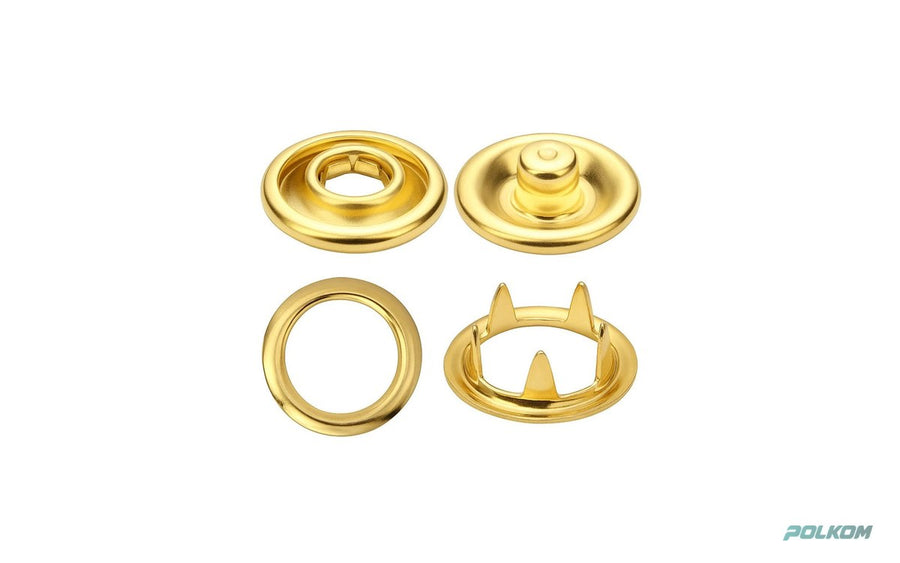
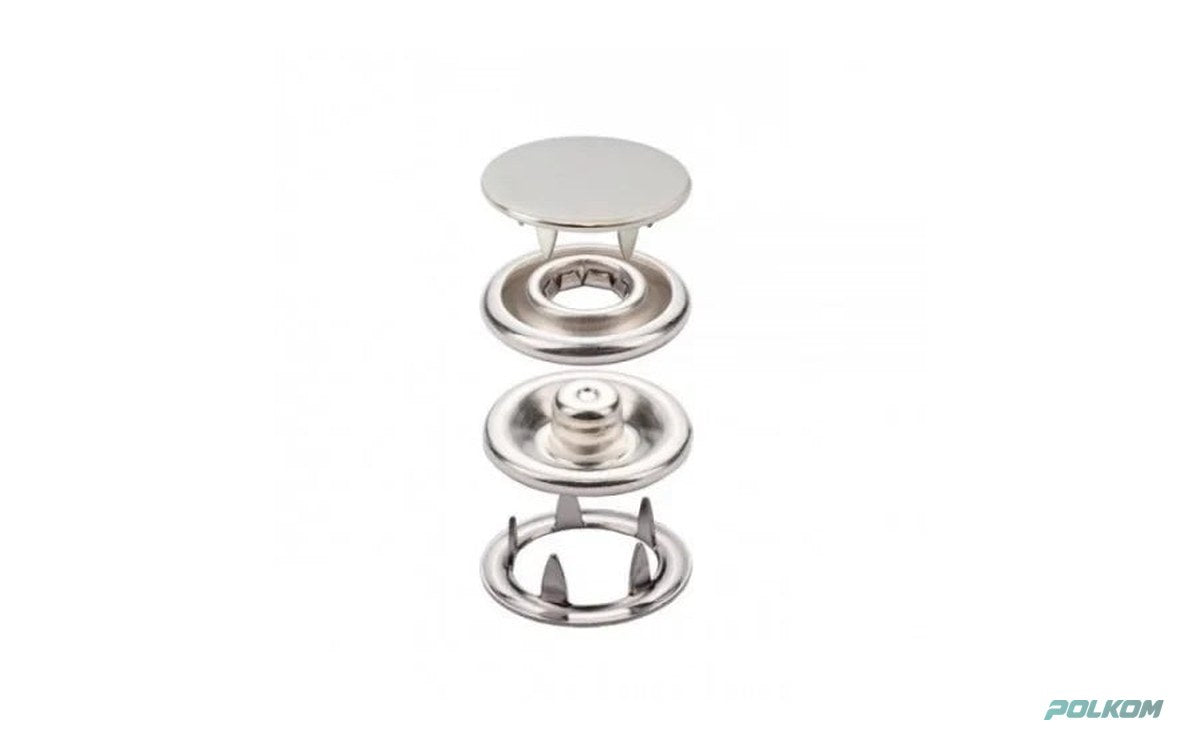
| Prong (chico), PR | 4 parts: top part (ring or prong cap), socket, stud, bottom prong ring | 6.8–22 mm; coloured and mesh rings 11.5–30 mm (on request) | hand press, lever press, motorised and automatic machines |
| 54 system | 4 parts: cap, socket with spring, stud, post with tube | 9–30 mm | hand press, lever press, motorised and automatic machines |
| 61 system | 4 parts; 6 parts for the double-sided model | 10.6–30 mm | hand press, lever press, motorised and automatic machines; H61-70 – the stud is screwed in |
| Special systems | cap from the 54 or 61 system, aluminium or steel post, magnetic core – depending on the model | 10.5–30 mm; some models on request | hand press, lever press, motorised and automatic machines |
| Sew-on | 2 parts with holes for sewing | 8–30 mm | sewn on by hand or by machine – no die |
Even within one system, sizes are close but not identical. For example, the slim system SP-50 is available in 10.85, 10.95 and 11 mm, and the mini 61 system H61-30 in 10.7, 10.8 and 11.5 mm. The die is selected by the exact code and size, not “by eye”.

Prong versus spring systems
With prong snaps (chico), the die bends the prongs through the fabric without cutting it. With the 54 and 61 systems, the die spreads the tube of the post or the cap. That is why a prong tool is not used for a spring system and vice versa – the shape of the working surface is different.
Models with a different attachment method
- H61-40 with a double-sided stud has 6 parts – the snap works on both sides of the item, which requires carefully selected tools.
- H61-70 with a screw is fixed to rigid bases – the stud is screwed in and no press is used on the underside.
- SP-30 and SP-40 have a post in the bottom part – the matching die is for the post, not for a post with a tube.
- The sew-on SW-10 and SW-20 do not need a die.

Hand press, lever press or machine
All press-on systems in the catalogue can be set on a hand press, lever press, motorised and automatic machines. The choice depends on the volume and on how consistent the result needs to be.
| Equipment | When it is suitable | What to watch out for |
|---|---|---|
| Hand press | samples, small runs, ateliers | the force depends on the operator – every snap needs checking |
| Lever press | regular production, medium runs | a more even stroke; centring and die wear are important |
| Motorised and automatic machines | large runs and consistent quality | the force is set for the specific fabric and checked on the first pieces |
Whatever the equipment, it is the die that determines whether the snap is set correctly. A good press with the wrong die gives a poor result.
Signs of a wrong or worn die
Most setting problems come from the tool. Here are the typical symptoms:
- The prongs bend inwards or outwards – wrong die, incorrect stroke force or an off-centre die.
- A mark or dent on the cap – too strong a stroke or a worn die; the solution is a lighter stroke, replacing or polishing the die.
- The fabric is cut or puckers – the fabric is not taut or the edges of the die are sharp.
- A weak click – deformation during setting or a wrong socket/stud combination; check the die and whether the parts are from the same system.
When you need to order a die
If you set the snaps in your own factory, you need a die in these cases:
- First order of snap buttons – for each new system and size.
- Change of size or model – for example moving from 12.5 to 15 mm or from the 54 to the 61 system.
- Wear – when marks appear on the cap or the spreading is uneven.
- A new press – check that the die fixing matches the press head.
In your inquiry, state the model code (for example S54-10 or PR-10), the size in mm and the type of press. The price of the die is on request.
A setting die and a logo tool are not the same
The setting die is used to attach the snap to the fabric. The embossed logo on the metal cap is made with a separate tool to your design. The two are specified separately in the quote – the price of both is on request. You will find more about logo techniques on the branding page.

Trial setting before the production run
The safest way to avoid problems with the die is a trial setting on the actual fabric. Send us fabric samples – we will do a trial setting and recommend the model, the prong length and the press setting. If needed, we prepare a technical sheet with setting instructions for your fabric. Spring systems must withstand a pull test of at least 90 N and a fastening force of at least 15 N for 10 seconds – the test also shows whether the die and the stroke force are correct.
Polkom – snaps, dies and advice
Polkom is a manufacturer of accessories for fashion, furniture, footwear and bags with over 30 years of experience. Besides the snaps, we also offer a service for attaching buttons and accessories if you prefer not to invest in your own equipment. Send us an inquiry with the model, size and type of press – we will specify the die and send a quote. All models are in the snap buttons category.