Manufacturer · Fashion & Home Accessories











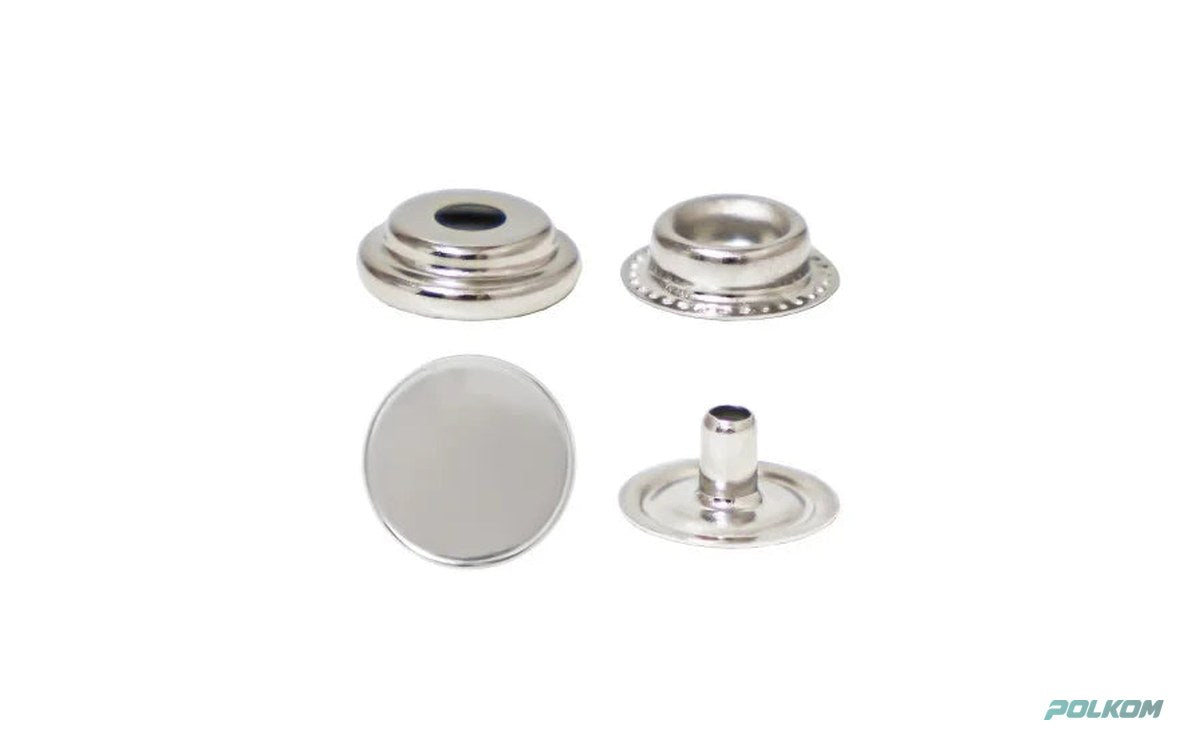
Snap buttons for workwear and uniforms are chosen from systems that withstand frequent fastening, heavy fabrics and industrial washing: the 61 system (for example H61-10 and H61-60), the heavy-duty special systems SP-40 and SP-90, and for a concealed closure S54-30. The requirements in the Polkom catalogue are a pull test of min. 90 N for the spring systems and a fastening force of min. 15 N / 10 s.
What puts strain on a snap in workwear
A work jacket, overalls or staff uniform is worn every day and washed much more often than a fashion garment. The snap button is subjected to:
- dozens of fastenings per shift – often with gloves or wet hands;
- dense and multi-layer fabrics – twill, denim, oilcloth, reinforced areas;
- strain on pockets carrying tools and phones;
- industrial washing and drying with high temperatures and strong mechanical action;
- rubbing against seats, belts and equipment.
So with uniforms it is not enough for the snap to look good on the sample. It must hold just as well after months of wear.
Snap buttons for workwear: the systems that last
The table shows the catalogue models most suitable for workwear, uniforms and related products:
| Code | Model | Material | Sizes | Logo | Uses |
|---|---|---|---|---|---|
| H61-10 | 61 standard | brass | 11.5; 12.5; 13; 14; 15; 16; 18; 19; 20; 25; 30 mm | yes | jackets, denim jackets, trench coats, coats |
| H61-60 | 61 with plastic segment | brass | 12.5; 14; 15; 17; 20 mm | yes | jackets, denim jackets, trench coats, coats |
| H61-70 | 61 with screw | brass | 15 mm (male part with short or long screw) | yes | fixing to rigid bases – wood, plastic; tarpaulins, covers, upholstery |
| SP-40 | Heavy-duty system with aluminium rivet | brass, aluminium rivet | 13; 13.3; 13.5 mm (mini with 54 cap, large with 61 cap) | yes | jackets, denim jackets, trench coats, coats |
| SP-90 | Heavy-duty system without logo | brass | on request | no | jackets, coats, trench coats |
| SP-80 | Stainless snap | stainless steel | on request | no | jackets, denim jackets, trench coats, coats; products exposed to moisture |
| S54-30 | 54 with concealed cap | brass | 10; 11; 12; 14; 16 mm | no | shirts, workwear, jackets, trench coats, knitwear |
| PR-11 | Open ring with long prongs | brass | 6.8; 7.8; 9.5; 10.5; 11.5; 15 mm | on the male part | heavier jersey, multi-layer areas, workwear |
The 61 system – the basis for work jackets
The 61 system is the strong spring system for dense fabrics – denim, wool, oilcloth and leather. H61-10 is available in eleven sizes from 11.5 to 30 mm and uses a cap from the 54 system, so the choice of look is wide. H61-60 has a plastic segment that gives a soft, quiet and even click – convenient for uniforms that are opened and closed many times a day.

Heavy-duty systems SP-40 and SP-90
SP-40 is a heavy-duty system with an aluminium rivet in sizes 13, 13.3 and 13.5 mm – a mini version with a 54 cap and a large one with a 61 cap. It takes a logo and is suitable for work jackets and trench coats. SP-90 is a heavy-duty system without a logo, with sizes on request, and is offered only in nickel and black nickel colours (nickel free). It is a good choice when the snap needs to be functional and discreet, with the branding elsewhere.

Concealed cap S54-30
With S54-30 the cap stays inside the fabric and there is no bump on top. The surface of the garment is smooth, and the snap does not catch or scratch. It is suitable for shirts, workwear, jackets and trench coats. The model comes without a logo.
Jersey: PR-11 with long prongs
Polo shirts and jersey tops in uniforms require a prong snap. PR-11 has long prongs that grip heavier jersey and multi-layer areas. On open-ring models the logo goes on the male part.
H61-70 with screw – for the equipment around the uniform
H61-70 is not a garment snap in the strict sense. Its male part is screwed into a rigid base – wood or plastic – with no press needed on the underside. It is used on tarpaulins, covers and upholstery: machine covers, covers for work vehicles, upholstered seats.
Tests: what 90 N and 15 N mean
| Test | Requirement | What it shows |
|---|---|---|
| Pull test | min. 90 N for the spring systems | whether the cap and bottom part stay in the fabric under a sharp pull |
| Fastening force | min. 15 N / 10 s | whether the snap stays closed under strain and does not come undone by itself |
A force of 90 N corresponds roughly to the weight of 9 kg. These values are the requirements for the snap, but the result in the finished garment depends on the fabric, the number of layers and correct setting. So the test is carried out on your fabric, with your die and press setting – before the production run. The most common reasons for a failed pull test are the wrong length of prongs or post, too thin a material and combining parts from different systems.
Industrial washing: how to protect the snaps
Uniforms are often washed in industrial washing machines with programmes that put more strain on metal accessories than domestic washing. A few practical rules:
- Fasten the garments before washing. This protects the springs and caps, and the snaps do not knock against the drum and other garments.
- Avoid chlorine bleach and strong oxidisers. They accelerate wear of the finish.
- Choose a suitable finish. Antique brass and tin oxide hide natural wear better than bright tones.
- For constant moisture, use stainless steel. SP-80 is a stainless snap that does not rust even with frequent moisture and washing.
- Dry completely. The garment should not stay wet for long in a bag or container.
- Test with the laundry programme. Wash several samples with the actual programme before the production run and check the snaps.
Uniforms with a logo
A logo snap is one of the easiest ways to make a uniform look like part of the corporate identity. The metal caps of H61-10, H61-60 and SP-40 take an embossed logo, while SP-90, SP-80 and S54-30 come without a logo. On metal caps the logo is embossed and is resistant to rubbing, because it is part of the cap itself. You will find more about the techniques on the branding page.
For a coordinated look, use one finish for all the metal accessories on the uniform – snap buttons, rivets and eyelets.

Series setting
- Snap buttons are set on a hand press, lever press or motorised and automatic machines – with a die for the exact system and size.
- Do not set the snap on a seam or edge where the thickness changes sharply.
- Reinforce the area with interfacing if the face fabric is soft.
- Use only an original set of parts from one system – mixing is a common cause of a weak click.
Inquiry for workwear
Polkom is a manufacturer of snap buttons and metal accessories with over 30 years of experience. Send us fabric or a finished detail from the uniform and a description of the conditions of use and washing via the contact page. We will do a test setting and suggest a model and a sample with your logo. All systems are in the snap buttons category.