Manufacturer · Fashion & Home Accessories




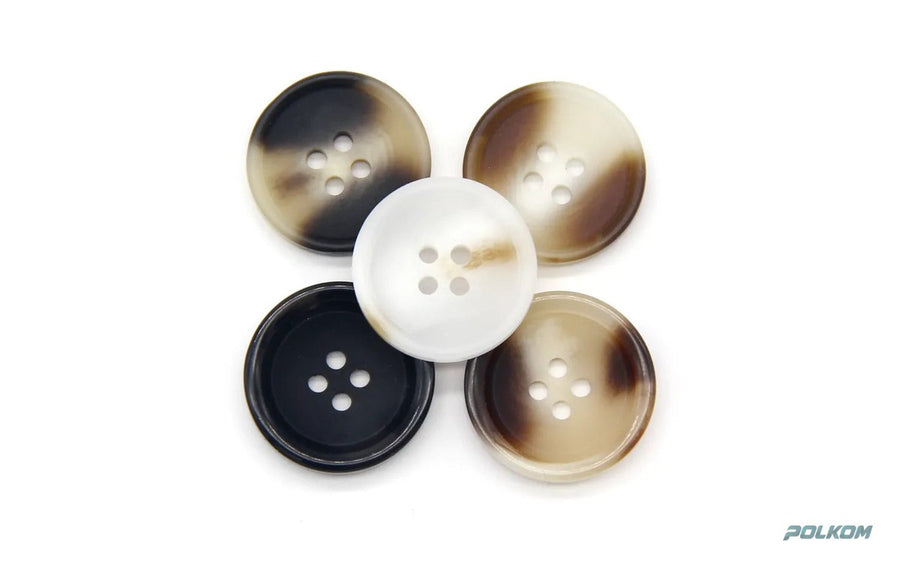
The question of washing clothes with coconut buttons has a short answer: it is trouble-free if you follow three rules – a moderate temperature, a gentle programme without long soaking, and no bleach. The garment is turned inside out, the buttons are fastened, and when ironing the iron is not placed directly on the button. Lacquered coconut buttons withstand washing better than untreated ones.
How coconut shell reacts to water and heat
Coconut shell is an organic material with fine pores. Brief contact with water does not change it, but with prolonged soaking it can absorb moisture, lose some of its natural oils and become lighter. Sudden temperature changes – hot water followed by fast drying on high heat – are the main cause of micro-cracks, especially around the holes. Lacquer seals the pores and reduces absorption, so for products that will be washed often it is a sensible choice.
The good news is that coconut does not melt or deform when ironed, as some plastic buttons do. The risk lies more in the tone drying out and fading than in mechanical damage.
Washing clothes with coconut buttons step by step
- Fasten all the buttons. This reduces knocks in the drum and strain on the thread.
- Turn the garment inside out. The buttons stay inside and do not rub directly against the walls of the machine.
- Choose a gentle programme. For linen and cotton – delicate or a shirt programme, with moderate spin speed.
- Follow the temperature on the label. For most garments with natural buttons, 30–40 °C is a safe range, if the fabric allows it.
- Use a mild detergent. No chlorine bleach or aggressive stain removers that can discolour the shell.
- Do not leave the garment to soak. Take it out as soon as the programme ends.
- Air dry. Lay the garment flat or hang it; avoid a tumble dryer on a high setting.
If the garment is heavily soiled, treat the stain locally with a mild detergent before putting it in the washing machine, rather than soaking the whole garment. This way the buttons are in contact with water only during the programme itself.
Ironing
When ironing, move around the buttons, not over them. A convenient method is to place the garment face down on a soft towel – the buttons sink into it and the iron glides evenly over the fabric. Steam does not harm coconut in brief contact, but a hot soleplate held on the button can leave a matt mark on the lacquer or dry out the natural surface.
Dry cleaning
Coconut buttons usually withstand professional dry cleaning, but every process is different. If the garment is intended for dry cleaning, good practice is to protect the buttons with foil or remove them temporarily – especially on expensive models with an engraved logo. As the garment manufacturer, it is sensible to test the sample with the actual process for which you will give instructions.
Common mistakes
- washing white linen shirts with natural buttons at 60 °C or more;
- soaking overnight with bleach or an oxygen-based product;
- tumble drying at the maximum temperature;
- ironing directly on the button;
- a high spin with unfastened buttons – they knock against each other and can crack;
- sewing on with weak thread that wears through at the edge of the hole.
What care to put on the label
If you produce clothing with coconut buttons, the care instructions must take into account both the fabric and the accessories. Care symbols are standardised in ISO 3758 and are placed on a care and composition label together with the fabric composition under Regulation (EU) 1007/2011. An example for a summer linen shirt with coconut buttons:
| Symbol | Meaning | Why |
|---|---|---|
| Washtub with 30 or 40 | wash up to the corresponding temperature | protects both the fabric and the buttons |
| Crossed-out triangle | do not bleach | protects the shell from discolouration |
| Crossed-out square with a circle | do not tumble dry | avoids drying out and cracks |
| Iron with one or two dots | iron at low to medium temperature | suited to the fabric and the button |
| Circle with the letter P or a crossed-out circle | dry cleaning allowed or not allowed | according to the model test |
You can also add the text "Iron on the reverse, without direct contact with the buttons" – it is easy for the consumer to understand and reduces complaints.
How to extend the life of the buttons at the production stage
- Choose a lacquered finish for products that will be washed often.
- Sew on with a suitable thread – polyester or cotton–polyester, strong enough for the fabric.
- Make a thread shank on thicker fabrics so the button is not under strain.
- Test a sample – at least five wash cycles at the temperature on the label, then compare tone and strength.
- Add a spare button – a small gesture that customers appreciate.
How to refresh faded buttons
If natural, unlacquered coconut buttons look dry after many washes, a drop of colourless oil or beeswax, applied with a cloth and well absorbed, restores the rich tone. This applies to the consumer at home; in production it is more practical to choose a suitable finish from the start.
Browse the available models in the coconut buttons category. If you are undecided between materials, also compare them with wooden buttons, which have similar care requirements.
Advice and samples from Polkom
Polkom is a Sofia-based manufacturer and wholesaler of garment accessories. We help brands choose a button finish according to the care method, offer care and composition labels with care symbols and make samples for testing. Send an inquiry via our contact form.