 Manufacturer · Fashion & Home Accessories











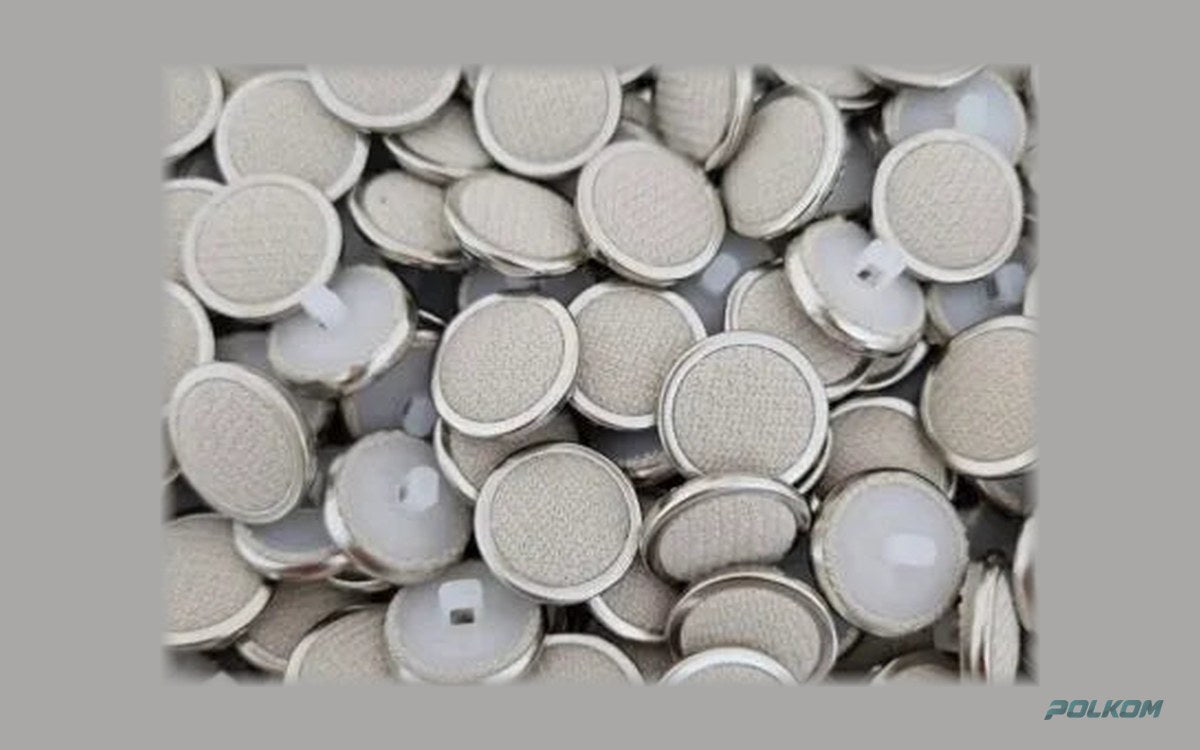
Fabric-covered buttons are buttons whose visible surface is covered with fabric, leather or another flexible material stretched over a rigid metal or plastic base. This gives the button exactly the colour and texture of the garment or furniture, instead of hunting for a ready-made button “to match”. They are used on dresses, suits, coats, bridalwear and upholstery.
What a covered button consists of
A classic covered button has two main parts:
- Top shell – domed or flat, usually made of thin metal. The fabric is stretched over it. The edge of the shell sometimes has small teeth that grip the fabric.
- Bottom part (back) – closes the button underneath and holds the edges of the fabric in place. It carries the shank for sewing or is flat with holes.
In industrial production the two parts are assembled with a press and die; at home, with a hand kit consisting of a mould and a pusher. In some cases a thin padding is placed between the fabric and the shell to soften the surface and stop the base showing through.
Which fabrics buttons are covered with
- Wool and wool blends – for coats, suits and jackets.
- Silk, satin, taffeta and shantung – for evening and bridal gowns.
- Velvet and plush – for occasionwear and upholstery.
- Linen and cotton – for summer dresses, shirts and blouses.
- Genuine and faux leather – for coats, jackets, bags and furniture.
- Lace – usually over a satin underlay, for bridalwear.
Almost any fabric can be used, provided it is not too thick to bend around the edge of the shell and not too sheer to hide the base.
Why fabric-covered buttons are used
A perfect match with the product
Ready-made buttons rarely match the fabric colour perfectly, especially with unusual shades, patterns and textures. A covered button is made of the same fabric and eliminates the problem.
A clean, elegant look
The button does not stand out as a separate detail but continues the line of the garment. That is why covered buttons are a classic in haute couture and bridal gowns.
Scope for contrast
Conversely, the button can be covered in a contrasting fabric – for example black satin on a white jacket or leather on a wool coat – and become a statement.
Uses beyond apparel
Upholsterers use covered buttons for buttoning (tufting) headboards, sofas and armchairs, and home textile makers for cushions and decorative details.
Fabric-covered buttons by shape
| Shape | Characteristic | Suitable for |
|---|---|---|
| Domed (ball) | high, convex profile | rows of buttons on the back of dresses, cuffs |
| Half-dome | moderately convex | blouses, dresses, jackets |
| Flat | low, with a slight rim | coats, suits, upholstery |
| With a rim | fabric in the centre, metal or plastic rim | designer styles |
Covered buttons with a shank or with holes
Most covered buttons have a shank underneath, because this keeps the face intact and the fabric unpierced. Upholstery uses buttons with a stronger loop or with prongs for fixing with twine and staples. Less often, flat covered buttons with holes in the back are made – when the button must sit as low to the fabric as possible.
What the limitations are
- Very thick fabrics are hard to bend around small shells – a larger size is chosen for them.
- Thin, sheer fabrics show the base and need padding.
- The metal base must be corrosion-resistant so it does not leave a stain through the fabric when washed.
- With heavy friction, the fabric at the edge of the button wears faster than the rest of the garment.
All of these issues are solved by choosing the right base, size and padding at the sample stage.
How to choose the size
The size of covered buttons is given in lignes (L), with 1L = 0.635 mm. Small sizes of around 14L–18L (9–11 mm) are used in long rows down the back of dresses and on cuffs. Medium sizes of 20L–30L (13–19 mm) are for blouses, dresses and jackets. Large sizes from 32L upwards (more than 20 mm) are for coats, suits and upholstery. The choice also depends on the fabric thickness – the denser the fabric, the larger the button needs to be to cover smoothly. The buttonhole or loop size is determined after choosing the button, not the other way round.
Caring for covered buttons
Covered buttons follow the care of the fabric they are covered with. If the fabric is washable, the button can be washed too, provided the base is corrosion-resistant. For silk, velvet and leather, dry cleaning is usually recommended. Iron around the buttons, not over them, so the edge of the shell does not leave an imprint and the fabric does not turn shiny.
Covered buttons in series production
For brands and garment factories, covered buttons mean one extra step – sending the fabric to the button manufacturer. In return, the product gets a detail that cannot be copied from a standard catalogue. It is important to send the fabric on time and in sufficient quantity so the buttons are ready when sewing begins. You will find more details on the models in the fabric-covered buttons category, and other unique solutions under buttons.
Fabric-covered buttons from the manufacturer
Polkom makes covered buttons to order and wholesale with the customer’s fabric or a material we select – for apparel manufacturers, ateliers, bridal boutiques and furniture makers. We make samples quickly and deliver across the EU. Send a piece of the fabric and a description of the product via the contact page, and we will suggest a suitable size and base.


