Manufacturer · Fashion & Home Accessories











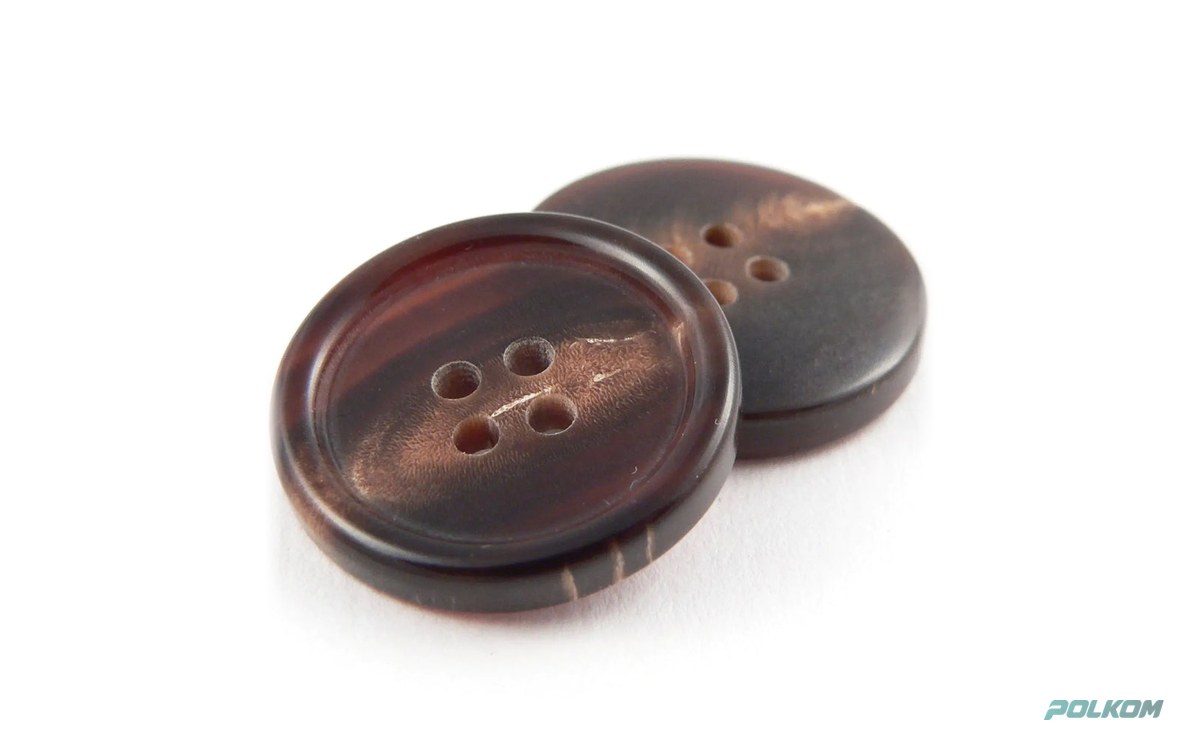
So, what are horn buttons made of? Genuine horn buttons are made from water buffalo horn. It is a natural material made of keratin, the same protein as hair and nails. The horn is a by-product of raising animals for milk and meat. It is not obtained by hunting, and the animals are not kept for their horn. That is why real buffalo horn buttons are both natural and practically zero-waste, and every button has its own unrepeatable pattern.
If you are looking for a general description of the material and how the buttons are made, read what is a horn button. Here we focus on the raw material: where it comes from, how it is graded and why buttons from one batch look different.
What exactly horn buttons are made from
Water buffalo horn is hollow at the base and solid towards the tip. On the outside it is dark, almost black, while the inner layers show brown, honey and light, almost translucent zones. Each horn yields a limited number of plates, from which button blanks are then cut. Part of the horn is not suitable for buttons and is used for other products – combs, handles, decorative objects.
Main types of raw material
- Dark horn – black to dark brown, the most common. The classic for jackets and coats.
- Light (white) horn – rarer and more valuable. Used for light-coloured garments and summer collections.
- Variegated horn – shading from light to dark, every button is different.
- Dyed horn – natural horn toned to a deeper colour. The pattern remains visible.
How the raw horn is sorted and graded
The quality of a horn button is decided as early as the selection of the plates. An experienced manufacturer assesses:
- Density – the solid part near the tip gives stronger buttons than the thin walls at the base.
- Colour and translucency – plates in similar tones are selected for one order.
- Natural marks – fine veining is characteristic of horn. Cracks and bubbles are removed.
- Thickness – determines which button size the plate can be used for.
After cutting, the blanks are ground, drilled and polished. It is in polishing that the deep lustre appears by which horn is recognised. The more carefully the raw material is selected, the less waste there is after processing.
So with real horn, "matching" means "within one tonal range", not identical. This is an advantage, not a defect. The pattern is how a buyer recognises the natural material.
Are horn buttons ethical?
Brands with a sustainability policy ask this question often. Here are the facts:
- Water buffalo horn is a by-product. If it is not used, it is waste.
- The material is natural and biodegradable. It contains no plastic.
- Processing is mainly mechanical – cutting, grinding and polishing.
For brands that do not use animal-derived materials, the closest natural alternative is corozo made from the tagua nut. If you need the same look at a lower price, choose imitation horn buttons (also called faux horn buttons).
Real horn, imitation or corozo
| Criterion | Real horn | Imitation horn | Corozo |
|---|---|---|---|
| Origin | Water buffalo horn | Polyester | Tagua nut |
| Pattern | Unique on every button | Repeating | Fine, matt |
| Feel | Cool, dense | Light, warmer | Dense, natural |
| Animal origin | Yes | No | No |
| Price class | Highest | Economical | High |
You will find detailed comparisons in the articles how to tell real horn from imitation and corozo or horn buttons.
Matt, gloss and shape – how finishing changes the look
The same raw material can look completely different depending on the finish. Polished horn has a deep lustre and brings out the pattern. Matt horn looks calmer and closer to the natural material. The two are often combined – a polished rim and a matt centre, or the other way round. The rim can be flat, rounded or raised, and the face concave, convex or flat. Jackets and coats call for a more pronounced rim and a concave centre; shirts and knitwear for a thinner, flatter button.
What to ask when buying horn buttons
Before you order, clarify the following with the manufacturer. It saves misunderstandings on delivery:
- Natural or dyed horn – both are natural, but the look is different.
- Tonal range – ask for samples of several buttons to see the variation in pattern.
- Thickness – for coats and jackets a thicker button is stronger and looks more expensive.
- Size in lignes – usually 32L for a jacket front, 24L for sleeves, 36–40L for a coat.
- Repeat orders – the tone of the next batch may differ slightly. If colour is critical, order the quantity for the whole season at once.
Caring for horn buttons
Horn withstands normal washing and dry cleaning. Avoid prolonged soaking and very hot water, as the keratin can lose its lustre. When ironing, do not press the iron directly on the button. If the surface dulls over time, a light polish with a soft cloth restores the shine.
Horn buttons from Polkom
Polkom is a button manufacturer with over 30 years of experience. We offer horn buttons in real horn in a range of shapes and sizes, with four or two holes and with a shank, including with a laser-engraved logo. All products are OEKO-TEX® certified. Samples depend on the model. The minimum order is generally 1,000 pcs per model, and higher for some buttons. Production takes 10–20 days. Send a request for a quote or sample.