Manufacturer · Fashion & Home Accessories











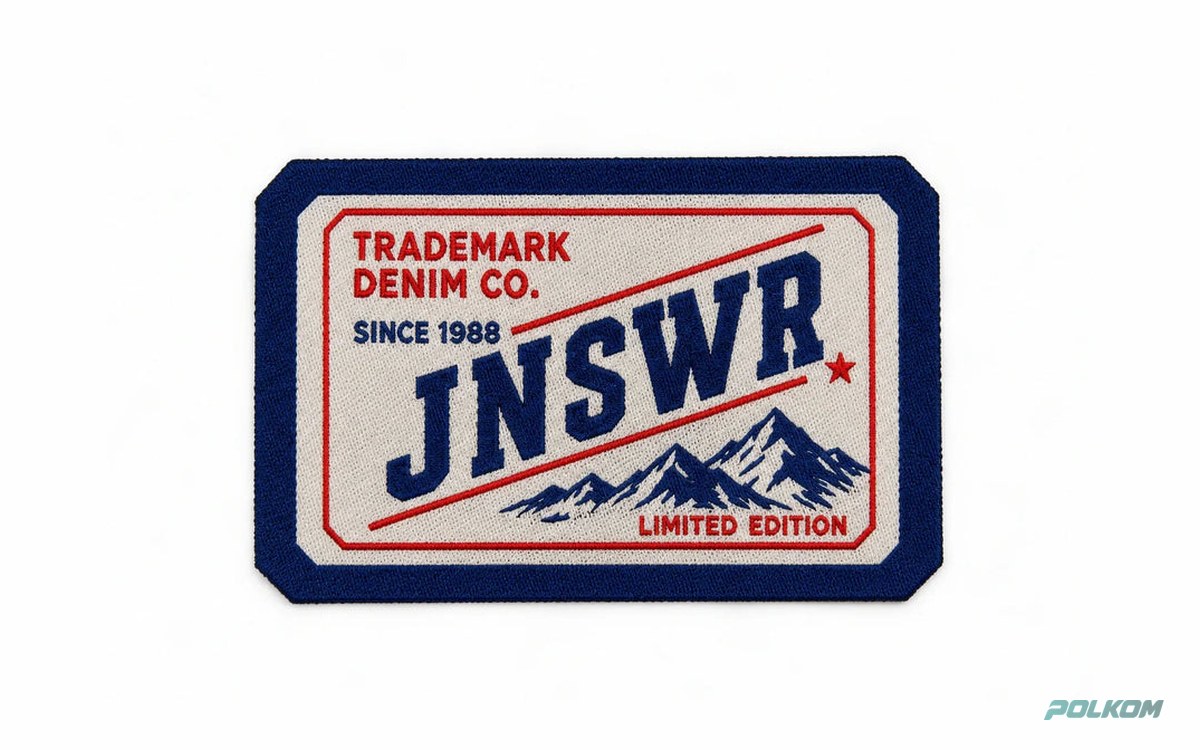
Woven logo patches are more durable and have a raised, “textile” structure, which makes them the first choice for uniforms, workwear and denim. Printed patches reproduce fine details, gradients and photographic images that cannot be woven. If the logo is simple and the patch will be worn and washed for a long time – choose woven; if the design is complex and multicoloured – printed.
Woven or printed patches – how each is made
A woven patch is woven on a jacquard loom: the coloured threads interlace so that they themselves form the logo. The image is part of the fabric, so it cannot wear off. The technique is the same as for woven labels, except that the patch is denser, often larger and is placed on the outside of the product.
A printed patch is made by applying the design to a ready-made base – most often polyester twill or satin – by sublimation or another printing method. The dye penetrates the polyester fibres, so wash resistance is good and the number of colours is practically unlimited.
Comparison table
| Criterion | Woven patch | Printed patch |
|---|---|---|
| Detail | Good; very fine lines are simplified | Very high, including small text |
| Colours | Limited number of threads in the design | No practical limit, gradients |
| Surface | Textured, slightly raised | Smooth, flat |
| Abrasion resistance | Excellent | Good, depends on the base |
| Look | Classic, “uniform” | Modern, graphic, photographic |
| Typical application | Uniforms, workwear, denim, clubs | Merchandise, events, children’s clothing, promotional runs |
The border: merrow or laser cut
The edge determines how “finished” the patch looks and how long it will last.
- Merrow border – a dense overlock stitch around the edge. It gives the classic emblem look, protects the edge from fraying and is best for round, oval and rectangular shapes.
- Laser or heat-cut edge – the patch is cut exactly along the contour of the logo, and the heat seals the threads. This allows complex shapes, sharp corners and “cut-out” letters.
- Folded edge – the edges are folded back; suitable for rectangular patches that are sewn on around the perimeter.
On a complex shape with concave areas a merrow border cannot follow the contour, so cutting is used there. It is best to decide on this detail at the design stage, not after the sample.
Attachment methods
Sewing on
The most secure method for uniforms, jackets, backpacks and products that are washed industrially. The stitching runs along the border or the edge of the patch.
Iron-on
There is a heat-seal adhesive layer underneath and the patch is applied with a press. This is convenient for small runs and for branding finished garments. For heavy use and frequent washing, an additional seam along the edge is recommended.
Removable patch with hook and loop
The hook side of a hook and loop (Velcro) tape is sewn to the back, and the loop side onto the garment. This way the emblem can be changed according to the team, position or event. This solution is popular in workwear, with security companies and in outdoor equipment.
Which type for which product
- Uniforms and workwear – a woven patch with a merrow border, sewn on; if it needs to be changed – with hook and loop.
- Sports clubs and schools – woven for the main kits, printed for souvenir and anniversary runs.
- Denim and jackets – woven, often in muted tones, or cut along the contour for a more modern look.
- Caps and hats – a small woven or printed patch with a cut edge so it sits snugly on the curve.
- Merchandise and events – printed, when the design is an illustration or contains a photo.
- Children’s clothing – printed on a soft base or woven with a smooth back, without hard edges.
Size, shape and placement
The size of the patch is not just a matter of taste. If it is too large for the spot, it bends, peels at the edges or restricts movement. If it is too small, the logo loses legibility, especially with the woven technique.
- Chest and sleeve – the most common spots on uniforms and club kits; here it is important that the patch does not fall on a seam or pocket.
- Back – for large emblems and lettering; here the printed technique is often lighter and more flexible.
- Cap – a small patch that has to follow the curve; a firm backing is an advantage here.
- Denim – the back pocket, the waistband or the cuff; often combined with a woven label on the inside.
The shape can be round, oval, rectangular, a shield or cut along the contour. On curved areas and stretch fabrics, smaller and thinner patches hold better.
Common mistakes
- A woven patch with photographic details – the loom cannot reproduce smooth transitions and the result disappoints.
- Iron-on application onto nylon, silicone-coated or water-repellent fabrics without a test – the adhesive does not grip.
- A merrow border on a shape with sharp concave areas – the border “rounds off” the contour and the logo is distorted.
- A light background on workwear – it gets dirty quickly; a darker base lasts longer visually.
How to prepare the design
- Send the logo in vector format and state the final size of the patch.
- Check the smallest text: on a woven patch, very fine letters merge – enlarge or simplify them.
- Limit the colours for a woven patch and give the Pantone numbers.
- Choose the shape, border and attachment method – they affect the construction.
- Approve a sample on the actual fabric before starting the production run.
You will find all types of emblems and examples in the patches category.
Custom patches from Polkom
Polkom is a Bulgarian company from Sofia with over 30 years of experience as a manufacturer of accessories for fashion, furniture, footwear and bags. We make woven and printed patches to your design and help you choose the technique, border and attachment according to the product. Minimum quantities depend on the item. Send an inquiry with your logo, the size and the intended use of the patch.