 Manufacturer · Fashion & Home Accessories











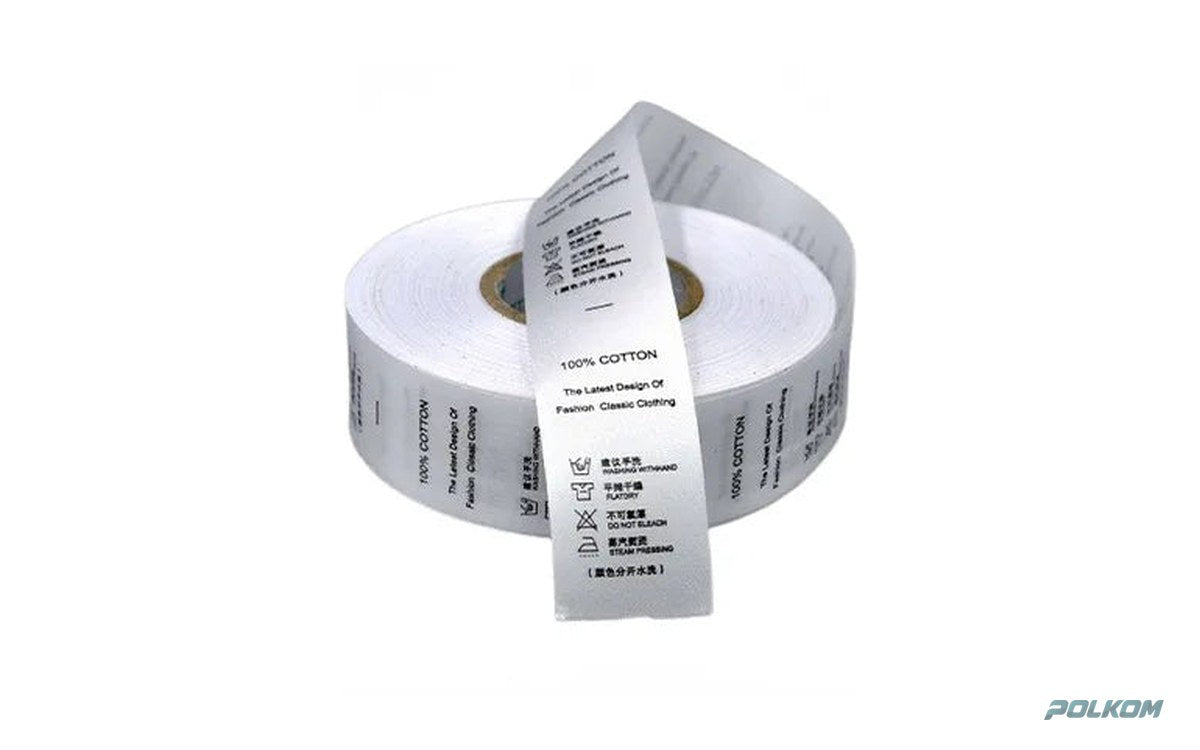
The language of a clothing label is determined by the market: the fibre composition must be in the official language or languages of the Member State in which the product is sold to the consumer. For Bulgaria that is Bulgarian. Care symbols are not translated, so when exporting to several countries a multilingual label is made on which only the text is repeated.
Clothing label language under Regulation 1007/2011
Regulation (EU) No 1007/2011 requires the labelling or marking of the composition to be in the official language or languages of the Member State in which the textile product is made available to the consumer, unless that Member State provides otherwise. In other words, the answer depends not on where the garment was sewn, but on where it will be sold.
- A garment sewn in Bulgaria and sold in Bulgaria – composition in Bulgarian.
- A garment sewn in Bulgaria and sold in Germany – composition in German.
- A garment sold in several countries from the same batch – composition in all the relevant languages.
The requirement applies to consumer information. In business-to-business commercial documents another language may be used, as long as the information is clear.
Countries with more than one official language
Some countries have several official languages – for example Belgium, Finland, Luxembourg or Malta. There all the languages may be required, or separate languages for separate regions. Before exporting, it is wise to check what the specific country requires or to ask your trading partner, who knows the local market surveillance rules.
What is translated and what is not
| Information | Translated? | Note |
|---|---|---|
| Fibre names | Yes | Using the official names in each language |
| “Lining”, “Outer”, “Filling” | Yes | For multi-component products |
| Care symbols | No | International, understood without text |
| Text instructions (“Wash separately”) | Yes | Recommended in all languages |
| “Made in…” | Advisable | Often written in English as “Made in…” |
| Size | Usually not | Letters and numbers are international |
How a multilingual label is prepared
Ordering the languages
Common practice is to precede each language with a two-letter country or language code, for example BG, EN, DE, FR, IT, ES, RO, GR. This way the buyer quickly finds their line. The codes denote the language and are not abbreviations of the fibres, so they are permitted. The fibre names themselves are written out in full.
One page or several
With two or three languages, the text usually fits on one side of the label. With more languages a multi-page label is made: several tapes printed on both sides are folded and sewn together into the seam. This keeps the label compact while still accommodating the composition in ten or more languages.
Font and legibility
The regulation requires the composition to be easily legible, clearly visible and in the same font for all fibres. With multilingual labels the temptation is to reduce the font to fit more text. It is better to add a page than for the text to become illegible after washing.
Cyrillic, Latin and Greek
If the label contains languages with different alphabets, such as Bulgarian, Greek and languages written in Latin script, you must use a font that supports all the characters. So when preparing the print file, check that no characters have been substituted – for example question marks or empty squares in place of letters. Send the text as an editable file, not as an image, to avoid transcription errors.
Language and online sales
The language requirement does not apply only to the sewn-in label. When you sell online, the composition information must be available to the buyer before purchase too, in the language of the market the shop targets. If your website sells in Romania and Greece, the product description must also contain the composition in Romanian and Greek. The sewn-in label and the online description must match – contradictions are a frequent cause of returns.
Common language mistakes
- A label only in the language of the country of manufacture, without the language of the market.
- Machine translation of the fibre names instead of the official names.
- A different font or size for individual languages.
- No translation of the words “lining” and “filling” for multi-component products.
How to organise the data for a multilingual label
- Create a table of the fibres you use and their official names in all languages.
- Link each article to its composition and symbols.
- Determine which markets each article serves.
- Prepare the label text from the table, without manual copying.
- Check the label sample before approving the run.
This way, for a new collection you only add new rows, while the translations stay the same and verified.
Language and composition labels
Multilingual text is usually printed on care and composition labels made of satin or taffeta, which withstand repeated washing. The main brand label, often a woven label, rarely contains text that needs translating – it carries the logo and sometimes the size. You will find the full range of solutions in the labels category.
Polkom – multilingual composition labels
Polkom is a Sofia-based manufacturer of labels and accessories for fashion, furniture, footwear and bags with over 30 years of experience. We print multilingual care and composition labels with one or several pages, with your logo, the care symbols and a text check before the sample. We deliver across the EU. Send an inquiry via the Contact page.




