Manufacturer · Fashion Accessories

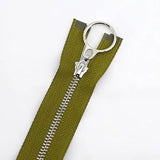


When choosing the length of an invisible zip, measure from the bottom stop to the top of the coil, without the tape. Choose a zip 2–3 cm longer than the opening: about 18–22 cm for skirts and trousers, 40–60 cm for dresses with a back seam and 20–30 cm for a side seam. If the zip is longer, a closed-end invisible zip is easily shortened from the bottom – with a hand or machine bartack across the coil and cutting off the excess.
How to measure the length of an invisible zip
The length of any zip is stated along the chain – from the bottom stop to the top stop (or the top of the coil). The tape above and below it is not included. An invisible zip has one particularity: the foot cannot sew right up to the slider, so the last 1.5–2 cm of the zip at the bottom are not sewn in. That is why the zip is always chosen longer than the actual opening.
The "+2–3 cm" rule
- Measure the opening of the finished garment – from the top seam (waistband, facing, neckline) to the point where the body passes through freely.
- Add 2–3 cm.
- Round up to the nearest standard length.
The excess stays below the seam, hidden on the inside, and does not interfere with wear.
Invisible zip length by garment
| Garment | Position | Approximate zip length |
|---|---|---|
| Skirt, women's trousers | Back or side | 18–23 cm |
| Dress | Side seam | 20–30 cm |
| Dress to the waist | Back seam | 35–45 cm |
| Dress to the hip, evening dress | Back seam | 50–60 cm and longer |
| Blouse, top | Back or side | 20–40 cm |
| Sleeve, cuff | Sleeve seam | 10–15 cm |
| Cushion cover | Bottom seam | About 5–10 cm shorter than the side |
The values are a guide. The final length depends on the pattern, the elasticity of the fabric and the size.
20 cm and 60 cm invisible zips – the two most common choices
An invisible zip of about 20 cm is the universal choice for skirts and trousers – it covers most sizes and styles. An invisible zip of about 60 cm is the standard for dresses with a back seam – long enough for hip-length styles and easy to shorten for shorter openings. Many ateliers stock exactly these two lengths in the main colours and shorten them as needed.
How to shorten an invisible zip
A closed-end invisible zip is shortened from the bottom, with no special tools.
With a machine bartack
- Close the zip and mark the new length on the tape.
- Set the machine to a dense zigzag with zero stitch length (bartack).
- Make 6–8 stitches across the coil exactly at the mark.
- Cut the zip about 2 cm below the bartack.
By hand
With a double thread, make several dense stitches across the coil and both tapes at the desired point. Secure the knot on the wrong side and cut off the excess.
The new "stop" ends up below the seam of the garment, so it is not visible. The bartack must be strong enough to stop the slider, otherwise it will come off the coil.
Shortening from the top
If the zip has to be shortened from the top – for example an open-end invisible zip – remove the top stops, cut off the excess and fit new stops or secure with a bartack before the slider can come off. Shortening from the top is more laborious and risky, so it is used only when the bottom is not possible.
Invisible zip by the metre
For ateliers and small series with many different lengths there is invisible zip chain on a roll, to which separate sliders are fitted. It gives flexibility but requires care when fitting the slider and stops. In series production, finished zips in the exact length are faster and of more consistent quality.
Length for stretch and non-stretch fabrics
The elasticity of the fabric directly affects the opening needed. With jersey and fabrics containing elastane the body passes through a narrower opening, so the zip can be shorter, and on loose knitted styles it is sometimes unnecessary altogether. With non-stretch fabrics – wool, linen, taffeta, brocade – the opening must be larger and the zip longer. For dresses with a fitted bodice in non-stretch fabric it is better to choose a longer zip that reaches slightly below the hip line than to have the dress put on with effort, straining the coil.
Length across the size range
In series production of skirts and dresses, sizes from XS to XXL have different opening lengths. There are two possible approaches:
- One length for all sizes – easier for stock, but on small sizes the excess is large, and on large sizes the zip may be short.
- Two or three lengths for groups of sizes – a more accurate result and less waste; recommended for fitted styles.
Sew samples in the smallest and largest size and check the opening at a fitting before ordering a series quantity.
Common length mistakes
- The zip is exactly as long as the opening – the garment is hard to put on.
- The zip was measured including the tape and comes out shorter.
- The bartack used for shortening is weak and the slider comes off the coil.
- An open-end invisible zip was shortened from the bottom and the mechanism was cut off.
Invisible zips in all lengths from Polkom
Polkom supplies wholesale invisible zips in standard and non-standard lengths and a wide range of colours, as well as original YKK invisible zips. If you are looking for other types, see our zips category. Send an inquiry with the lengths across the size range and the colours – we will prepare a quote and samples.