 Manufacturer · Fashion & Home Accessories











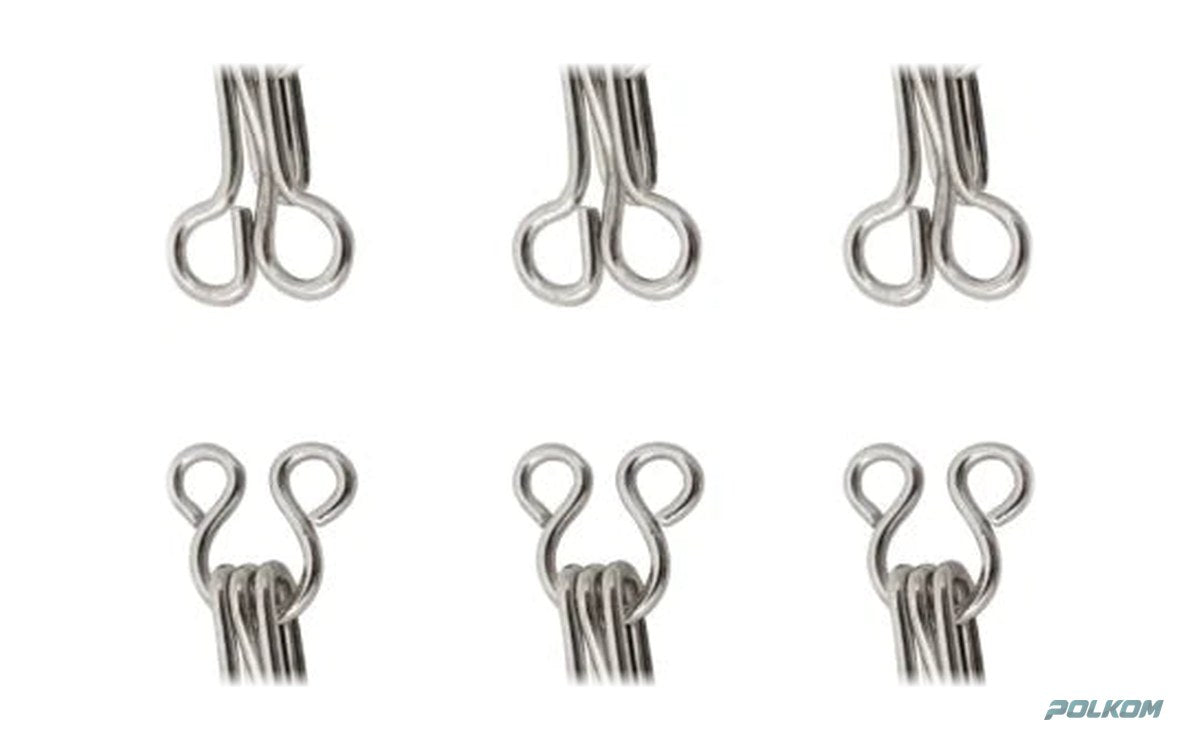
Large hooks and eyes are made from thicker wire and have a longer curve. They are used on coats, capes, fur and down garments, heavy wool dresses and waistbands – wherever the fastening carries more weight or passes through several thick layers. They provide a concealed closure where a small hook would bend or slip out.
When you need large hooks and eyes
Small hooks are designed for fine fabrics. With heavy fabrics three problems arise: the hook sinks into the material, is hard to engage and bends under load. A larger hook solves all three:
- thicker wire does not deform under tension;
- a longer curve engages securely through thick layers;
- a wider base spreads the load over more fabric.
Uses of large hooks and eyes
Coats and capes
On coats, large hooks are used at the top of the collar, on stand collars, on capes without buttons and on styles with a lapel that fastens invisibly. The hook keeps the collar closed against the wind without spoiling the line of the design. They are often combined with visible fabric-covered buttons – the buttons close the front, and the hook holds the collar.
Fur and down garments
Real and faux fur, as well as down coats and gilets, are often fastened with large hooks covered in thread. The reason is that a buttonhole is hard to make in fur, and a button can tear out together with a piece of the material. A hook sewn to the firm backing or to a binding solves this problem and stays hidden in the pile.
Skirt and dress waistbands
On waistbands of heavy wool or suiting fabric, a larger hook with a straight eye withstands the tension when sitting down. If the load is very high – on jeans or close-fitting trousers, for example – flat trouser hooks and bars, which are applied with a press or sewn on, are more suitable.
Stage and historical costume
In theatre costumes and historical reenactment, large hooks replace the zip where it would be an anachronism, and they withstand frequent dressing and undressing.
Covering the hook with thread
When a large hook remains visible, for example on a lapel or collar, the metal can be hidden by covering it with thread. The technique is simple:
- Sew the hook or eye in place.
- Take thread in the colour of the fabric, ideally polyester or silk.
- Cover the entire wire with dense buttonhole stitches or blanket stitch, each stitch lying tightly next to the previous one.
- Secure the end and hide the thread under the base.
A covered hook looks like part of the garment, is less likely to scratch the lining and does not clink when you move. Use a strong sewing thread, because the covering wears with every fastening.
Sewing onto heavy fabrics
- Use a thicker needle and doubled thread.
- Sew through the facing or binding, not just the top layer.
- Make at least 6–8 stitches through each loop.
- Also stitch down the neck of the hook so it does not tilt under the weight of the coat.
- With leather, use a needle with a cutting point and do not pull the thread too tight, so it does not cut through the material.
Comparison: large hook, trouser hook or button
| Fastening | Visibility | Load | Suitable for |
|---|---|---|---|
| Large wire hook | Hidden or covered | Medium to high | Collars, capes, furs, wool waistbands |
| Trouser hook and bar | Hidden | High | Trouser and skirt waistbands |
| Button and buttonhole | Visible | High | Coat or jacket front |
| Sew-on snap fastener | Hidden | Low to medium | Flaps, pleats, light garments |
How many sets and where
On outerwear, the number of hooks depends on the role they play. If the hook only holds the collar closed, one set at the top is enough. If a cape or wrap fastens entirely invisibly, the sets are placed along the full length of the opening at equal intervals – closer together at the top, where tension is greatest, and further apart lower down.
On fur coats and gilets, the first hook goes at the collar, the second at chest level, and the rest are spread down to the waist or hem. Mark all positions in advance with a template and sew on all the hooks first, then the eyes – this way the opening stays straight and does not ripple.
Combining with other fastenings
A large hook is often a supplement rather than the only fastening. A typical example is a coat with visible buttons where the hook holds the collar, or a skirt with a zip where a hook holds the waistband. Plan all the fastenings of a style together so they match in style and colour.
Colours
Large hooks and eyes come in the same basic colours as small ones – silver, gold and black. Black ones suit dark coats and furs best, while silver and gold suit light tones or designs where the metal is part of the look. If the hook will be covered with thread, its colour does not matter.
Common mistakes
- A small hook on a coat collar – it bends within the first few wears.
- Sewing only through the top layer – the hook tears the fabric under tension.
- Covering in a contrasting colour when the hook should be discreet.
- A wire hook on a denim waistband, where a trouser hook and bar is needed.
See the sizes and colours in the hooks and eyes category.
Large hooks from Polkom
Polkom is a Sofia-based manufacturer of accessories for fashion, furniture, footwear and bags with over 30 years of experience. We supply hooks, buttons, trouser hooks and threads for outerwear from a single source and deliver across the EU. Send us a description of the style, the material thickness or a sample via the inquiry form, and we will suggest the right size.




