Manufacturer · Fashion Accessories

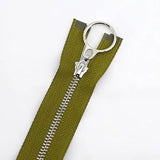


The length of a metal zip is measured along the teeth only – from the bottom stop to the top stop, without the extra tape. A long metal zip of 60, 80 or 90 cm is chosen according to the opening of the finished garment, and if the zip is longer than needed it is shortened from the top: the top stops are removed, the surplus teeth are taken off with pliers and new stops are fitted.
How to measure the length of a metal zip
The most common mistake when ordering is measuring the length including the tape. All manufacturers state zip length along the chain:
- Closed-end zip – from the bottom stop to the top stop.
- Open-end zip – from the bottom of the retainer box to the top stop.
- Two-way zip – also along the chain, with the sliders at their end positions.
The extra tape above and below the teeth (usually about 1–3 cm on each side) is for sewing in and is not included in the length. If in your pattern the ends of the zip go into a waistband, binding or hem, take this into account in advance.
60 cm, 90 cm and long metal zips – where they are used
| Length | Typical use | Usual construction |
|---|---|---|
| 10–20 cm | Jeans, trousers, pockets, skirts | Closed-end |
| 20–40 cm | Bags, pouches, sleeves, boots, children's jackets | Closed-end or open-end |
| 45–65 cm | Short jackets, sweatshirts, bombers | Open-end |
| 60–80 cm | Hip-length jackets, gilets, front-zip dresses | Open-end, sometimes two-way |
| 80–100+ cm | Parkas, coats, long jackets, sleeping bags, covers | Two-way open-end or closed-end |
Searches for "60 cm metal zip" and "90 cm metal jacket zip" reflect exactly these two popular classes – mid-length and long jackets. Long metal zips over 90 cm are also typical of coats, furniture covers, garment bags and technical products.
How to determine the length you need
- Measure the finished opening of the garment, not the pattern – seams and hems "eat up" anything from a few millimetres to centimetres.
- For a jacket, measure from the hem to where you want the zip to stop – below the collar or at its top.
- For trousers, measure from the top edge of the waistband to the end of the fly opening and subtract the waistband width.
- Round to a standard length, or order to measure if the series is large.
- For a size range, measure the opening for each size – for jackets the difference between S and XXL is often more than 5 cm.
How to shorten a metal zip
If the zip is longer than the opening, the metal chain can be shortened. The procedure requires care but is perfectly feasible in an atelier.
Tools needed
- end-cutting pliers (end nippers) or special zip pliers;
- small flat-nose pliers for fitting stops;
- new top stops for the same chain gauge;
- tailor's chalk or a marker.
Steps
- Mark the desired length on both tapes. With closed-end and open-end zips shortening is always done from the top, because the bottom has the stop or the box mechanism.
- Carefully remove the top stops by prising them open with the pliers.
- Remove the surplus teeth one by one, gripping each tooth with the end-cutting pliers and pulling it off the tape. Do not cut the tape.
- Leave about 1.5–2 cm of tape without teeth above the new limit – it is needed for sewing in.
- Fit the new top stops right above the last tooth and squeeze them firmly so that they grip the tape.
- Check the slider's travel and that it stops at the stops.
On a closed-end zip for trousers or a bag, a dense bartack through the tape can be made as a temporary solution instead of a new stop, but with metal the machine stitch must not pass through the teeth themselves.
When shortening is not a good idea
In series production manual shortening is slow and produces inconsistent quality. Moreover, with two-way zips and zips with a logo slider every mistake means a lost, expensive article. If you work with tens or hundreds of pieces, order zips in the exact length – the manufacturer makes them with factory-fitted stops.
Common length mistakes
- Measuring from the pattern. The pattern does not account for hems, waistbands and seam allowances – the zip comes out longer than the opening.
- Including the tape in the measurement. The result is a zip 3–5 cm shorter than needed.
- A jacket zip that is too short. If the zip stops below the collar rather than at its edge, the jacket does not close snugly and lets in the wind.
- One length for the whole size range. On small sizes the box ends up below the hem, and on large sizes the zip falls short.
- A two-way zip ordered as one-way. On long coats this is felt immediately when sitting down.
Before a series order, sew at least one sample in the smallest and the largest size. This will check whether the lengths across the size range have been calculated correctly.
Metal zip by the metre or finished length
Besides finished zips there is also metal chain on a roll, to which separate sliders and stops are added. It is convenient for samples, repairs and very non-standard lengths, but requires tools and experience. For series orders, finished zips in the exact length are faster to sew and more consistent.
Long metal zips to measure from Polkom
Polkom supplies metal zips in standard and non-standard lengths – from short zips for jeans to long open-end and two-way zips for jackets and coats. If plastic options suit your style better, see our moulded plastic zips or original YKK metal zips. Send an inquiry with the lengths across the size range, the gauge and the finish – we will prepare a quote and samples.