Manufacturer · Fashion & Home Accessories
Contents
Metal buttons for knitwear and cardigans give knits a finished, more classic look – from the nautical cardigan with gilt buttons to the chunky winter cardigan with antique metal. Knitwear, however, is a soft and stretchy material that reacts to the weight and shape of a button far more strongly than the fabric of a jacket or coat. That is why there are a few rules worth following at the sample stage when choosing a metal button for knitwear. For natural materials in the same use, see also horn buttons for knitwear.
Why shank buttons are preferred for knitwear
A shank button is sewn on with thread that passes only through the shank, not through the face of the button. This leaves a small space between the button and the knit, which takes the thickness of the opposite band of stitches. There are several advantages:
- the knit is not pressed or puckered around the button;
- the thread does not cut the stitches, because the load is taken by the shank;
- the button sits upright instead of drooping;
- buttoning is easier, even on chunky knits.
You can read more about this type of button in the article metal shank button.
Weight – the most important factor for knitwear
A heavy metal button on a thin cardigan gradually stretches the button band, which starts to ripple. When choosing a button, take into account the thickness of the knit and the density of the button band:
| Type of knit | Recommended button | Note |
|---|---|---|
| Fine knit, summer cardigan | a light, smaller button, stamped from brass or hollow | avoid solid cast designs |
| Classic cardigan with a medium knit | a medium shank button, flat or slightly domed | the button band is best reinforced with tape |
| Chunky winter cardigan | a larger, more solid button, including die-cast zinc alloy | the dense knit carries the weight |
Button size relative to the knit
Button size is given in lignes (L), where 1L = 0.635 mm. With knitwear, size is determined not only by the look but also by the density of the knit: on a chunky knit a small button slips out of the buttonhole, and on a fine knit a large button looks heavy. As a guide, smaller sizes are used for fine cardigans and larger ones for chunky winter cardigans, in the range of outerwear buttons. If you want to compare with other garments, see button sizes in lignes and millimetres.
Buttonhole or opening in the knit
In knitwear, the buttonhole is often an opening left during knitting rather than one cut and finished by machine. Such an opening stretches over time, so the button should be slightly larger than it and have a well-defined edge. For buttonholes cut into a finished knit, the edge is finished densely so that the knit does not unravel.
Reinforcing the button band
- tape on the inside – grosgrain or a thin cotton tape along the length of the button band prevents stretching;
- backing button – a small flat button on the inside takes the load and protects the knit; details in the article backing buttons;
- interfacing the area around the button on thinner knits.
Finishes for cardigans
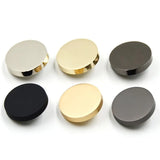
Gold and light gold emphasise the classic nautical style and go well with navy, white and cream knits. Antique brass and antique copper look natural with brown, beige and green tones, and gun metal and black with grey and dark cardigans. All Polkom metal buttons are nickel free – with us, "nickel" is only the name of the silver-tone colour of the finish.
Number and placement of buttons
On cardigans, the number of buttons depends on the length of the design and the thickness of the knit. Short cardigans often have 4–5 buttons, and long cardigans 6 or more, or just a few buttons at the top. On chunky knits the spacing between buttons is wider because the button band is more stable; on fine knits it is narrower so that the garment does not gape between buttons. The first button is placed at the height where the neckline should close, and the last one slightly above the hem so it does not pull on it. If the buttons are a decorative accent, you can also choose a combination of a larger top button and smaller buttons along the band.
Washing cardigans with metal buttons
Knitwear is often washed on a delicate cycle or by hand. It is advisable to turn the garment inside out and button it up so that the buttons do not catch on the drum. You will find more tips in the article caring for metal buttons in the wash.
Metal buttons from the manufacturer
Polkom manufactures metal buttons with shanks and with holes, stamped from brass and die-cast in zinc alloy, in a wide range of finishes, as well as buttons with a raised logo to your design. The minimum quantity for custom production is 1000 pcs, samples cost 50–100 €, and the production run is ready 10–20 days after sample approval. We deliver across Europe.
Share this article