 Manufacturer · Fashion & Home Accessories











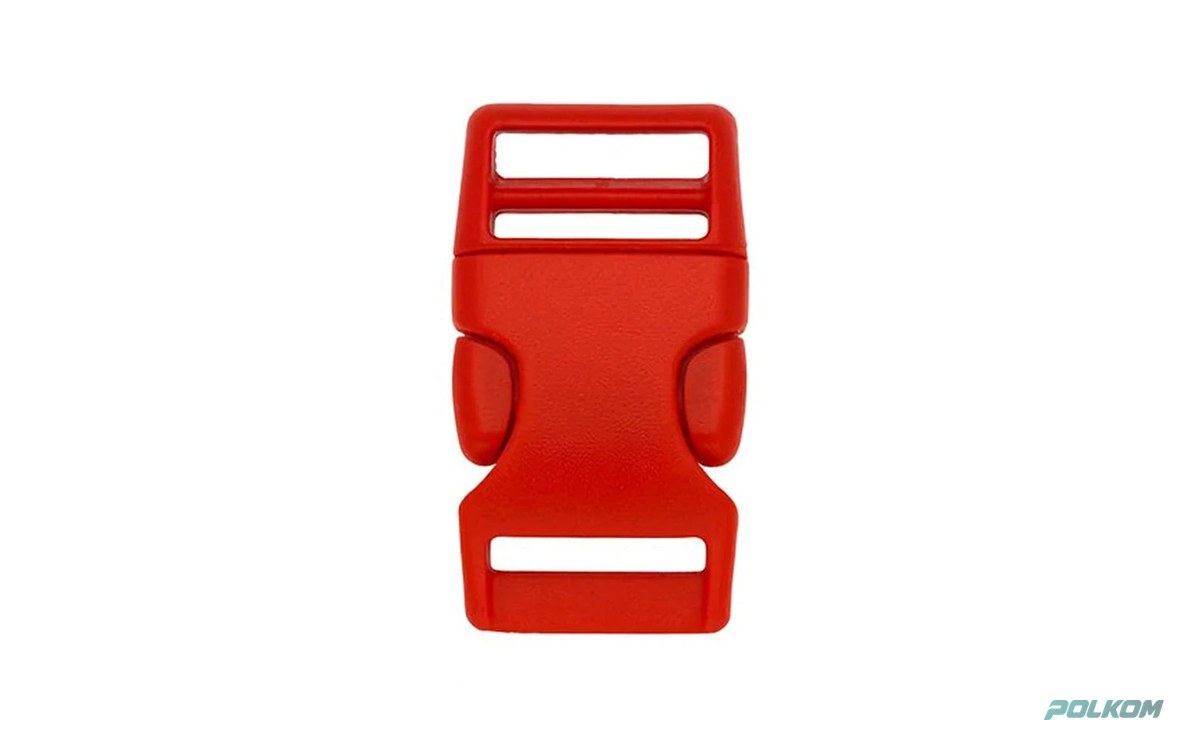
Plastic side release buckles are the quickest way to fasten a strap: the two parts meet, there is a click and the belt, bag or strap is closed. They release by squeezing both sides, without loosening the webbing. Polkom is a manufacturer of plastic side release buckles in sizes 1, 2, 3, 4 and 5 cm – for belts, bags and workwear, in two models and a wide range of colours.
Below you will find the difference between the two models, the full list of colours, a size table and practical tips for choosing by product.
How a plastic side release buckle works
A side release buckle (also called a quick release or snap buckle) consists of two parts. The male part has two flexible arms that slide into the female part and lock into its side openings. To open it, the arms are pressed together from the sides and the male part comes out. Each part has a bar the webbing passes through, and on the adjustable model the free end of the webbing lets you change the length without stitching.
The mechanism is simple, and that is exactly why it is reliable: the buckle closes with one hand, does not rust and does not scratch the fabric. This is why side release buckles are standard on textile belts, bag straps and work gear.

Model A and model B: what is the difference
Model A – classic side release buckle
Model A is the classic shape with a smooth front and a clean silhouette. It suits applications where the buckle should look tidy – on textile belts, shoulder bags, cases and tool straps. It is available in 9 colours: red, yellow, green, blue, grey, white, navy blue, dark green and khaki.


Model B – buckle with adjuster and ribbed surface
Model B combines the click closure with length adjustment. Its ribbed surface is easy to grip, even with gloves, which makes it practical for workwear and for straps that are tightened often. It is available in 7 colours: red, yellow, blue, green, white, olive green and grey.


| Model | Features | Colours |
|---|---|---|
| Model A | classic side release buckle, smooth front | red, yellow, green, blue, grey, white, navy blue, dark green, khaki |
| Model B | side release buckle with adjuster, ribbed surface | red, yellow, blue, green, white, olive green, grey |
Sizes: from 1 to 5 cm
The size of a side release buckle is defined by the width of the webbing that passes through it. If the webbing is 3 cm, the buckle must also be for 3 cm – wider webbing will not fit the bar, and narrower webbing will slip. We make plastic buckles in five sizes:
| Size (webbing width) | Typical use |
|---|---|
| 1 cm | thin straps, children's items, small cases, accessories |
| 2 cm | waist bags, shoulder straps on small bags, narrow belts |
| 3 cm | textile belts, shoulder bags, workwear straps |
| 4 cm | wide belts, sports and travel bags, tool straps |
| 5 cm | workwear belts, loaded straps and bags |
Before ordering, measure the actual width of the webbing, not just the nominal one – some webbings are slightly wider or thicker than stated. If you are unsure, send us a piece of the webbing and we will check which size fits.
Plastic buckles for belts
On textile belts, a side release buckle replaces the classic prong buckle with holes: the belt fastens quickly and the length is set via the free end of the webbing. Such belts are used in sports and children's collections, uniforms and outdoor clothing. For belts, sizes 3 and 4 cm are chosen most often. More on choosing the webbing and sewing the belt in the article buckles for textile belts.

Plastic buckles for bags
On bags, a side release buckle fastens the flap, joins the shoulder strap to the body or closes outer pockets. A coloured buckle can be an accent in the design – a red or yellow buckle on a dark bag – or match the webbing to stay unnoticed. For backpacks, where the load and number of buckles are different, see plastic buckles for backpacks, and for tri-glide sliders see strap adjusters and sliders.
Plastic buckles for workwear
In workwear, buckles must fasten quickly, withstand frequent washing and not snag. Plastic does not rust and does not conduct heat like metal, and the colour can match the uniform – khaki, navy blue, dark green, olive green or grey. Model B with its ribbed surface gives a secure grip even with gloves. A full overview of the trims in this category is in the article haberdashery for workwear.

Fitting the webbing into the buckle
The female part is usually sewn in fixed: the webbing goes through the bar, is folded and stitched with a box or cross stitch. The male part, especially on the adjustable model, stays free – the webbing passes through the bar and its free end is used for tightening. The end of synthetic webbing should be heat-sealed so it does not fray or slip out of the buckle. If buckles are sewn in series, make a few test pieces first to check that the stitching does not interfere with the click.
How to choose a plastic side release buckle
- Webbing width – the buckle must be the same size: 1, 2, 3, 4 or 5 cm.
- Adjustment – if the length needs to change often, choose model B with adjuster.
- Look – for a clean look choose model A, for a practical, technical look choose model B.
- Colour – matching the webbing for a discreet look, or a contrast colour as an accent.
- Set – order webbing, buckles and other accessories together so the colours match.
Webbing for belts and straps can be found in the technical tapes category, and a comparison of all fastening types is in the article types of buckles.
Plastic buckles from the manufacturer – Polkom
Polkom has worked with clothing, bag and footwear manufacturers for over 30 years. Plastic side release buckles are available in two models, five sizes and the colours listed above, and for larger runs we can discuss another colour. All our products are covered by an OEKO-TEX® certificate, and we deliver across the EU. Browse our plastic buckles and send us an enquiry with the model, size, colour and quantity.




