Manufacturer · Fashion & Home Accessories











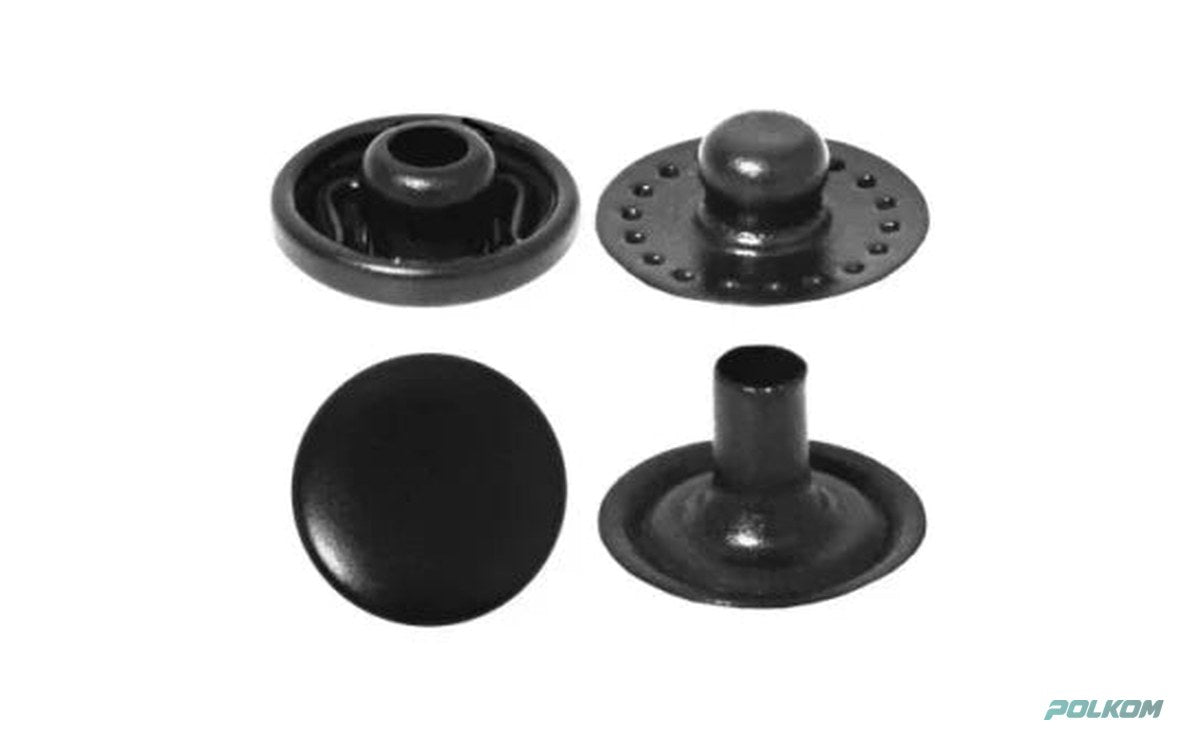
Snap button durability is checked with two main tests: a pull test, in which the button must withstand at least 90 N without tearing out of the fabric, and a holding force check – at least 15 N for 10 seconds. Beyond the tests, however, durability depends on the material, the finish, the right system for the fabric and the setting. Here is what lies behind the numbers and how to get snaps that last the whole life of the product.
Durability tests for snap buttons
| Test | Requirement | What it shows | When it is done |
|---|---|---|---|
| Pull test | min. 90 N for spring systems | whether the button is firmly fixed in the fabric and cannot be torn off | after trial setting and periodically during the run |
| Holding force | min. 15 N / 10 s | whether the button stays fastened and does not open by itself under light load | on the first pieces and when changing die or fabric |
| Visual check | no bent prongs, marks or rotating cap | whether the setting is centred and with the right force | on every batch |
| Check after washing | no loosening, corrosion or colour change | how the button and finish hold up in real use | on a sample of the finished garment |
These values are the minimum requirements in the Polkom catalogue for spring systems. They apply to a correctly set button on a suitable fabric – which is why the test is always done on the real material of the product, not just on the button.
Pull test
In the test, the button set in the fabric is gripped with clamps and pulled with increasing force perpendicular to the fabric. The result is a pass if at 90 N the button does not tear off, the prongs do not open and the fabric does not tear around it. If the test fails, the cause is almost always the wrong prong length, thin material without reinforcement or the wrong combination of parts.
Holding force
The second test checks the mechanism: the fastened button must hold a load of 15 N for 10 seconds. This ensures the garment will not come undone by itself during movement, while the button can still be opened by hand. Babywear calls for a softer click, jackets for a stronger one, but in both cases the minimum must be met.
Materials and durability
| Material | Models (examples) | Properties |
|---|---|---|
| brass | PR-10, S54-10, H61-10, SW-10 | corrosion-resistant, the main material of most models; takes all finishes |
| stainless steel | SP-80 | does not rust even with frequent moisture and washing |
| zinc alloy | SW-20, SP-20 | solid, substantial look, suitable for larger models |
| aluminium post | SP-40 | light and strong lower part in the heavy-duty system |
| phthalate-free and PVC-free caps | PR-40, PR-50, S54-40, H61-50 | mother-of-pearl, marble, crystal and plastic caps in a colour matched to a sample |
All models are nickel free in every finish, and an OEKO-TEX® certificate is available for Polkom products. For outerwear and bags, the 61 system and the special systems are suitable, while for knitwear and babywear the prong models are the right choice.
What shortens a snap button’s life
- The wrong system for the fabric – a 54 system on a heavy jacket comes undone and wears faster; a 61 system on a thin shirt tears the fabric.
- Unsuitable prong or post length – the button is not fully set and loosens over time.
- Mixed parts – socket and stud from different systems deform the spring.
- Too strong a strike – marks the cap and weakens the spring right at setting.
- No reinforcement – with knits and thin fabrics, the fabric tears around the button.
- Aggressive washing – bleach and harsh detergents damage the finish.
How to make snap buttons more durable
- Choose the system by fabric and load, not just by size.
- Reinforce the spot with interfacing or tape on knits and stretch fabrics.
- Do not place the button over a seam or an area where the thickness changes.
- Use a die for the exact size and system and adjust the strike force.
- Do a trial setting and pull test before the run and check periodically.
- Recommend in the care instructions washing the garment fastened and without bleach.
Washing and care
A fastened garment is washed more gently – the caps do not hit the drum or snag other garments. For garments exposed to constant moisture, choose the stainless SP-80 model. Mother-of-pearl, marble and plastic caps should not be ironed directly with a hot iron.
Logo durability
The logo must also withstand use. An embossed logo on a metal cap is the most durable, because it is part of the shape and cannot rub off. A laser logo on mother-of-pearl and marble is long-lasting, and on a transparent mother-of-pearl cap the print underneath is protected by the clear layer. The techniques are described on the branding page.
Technical sheet and trial setting
If needed, we prepare a technical sheet with setting instructions for the specific fabric: model, prong length and press settings. Send us fabric samples – we will do a trial setting and check the result. For other metal details in the same finish, see the eyelets and rivets categories.
Inquiry
Polkom manufactures snap buttons with verified technical parameters and produces caps with your logo to order. Write to us via the contact page or browse all systems in the snap buttons category.