Manufacturer · Fashion Accessories



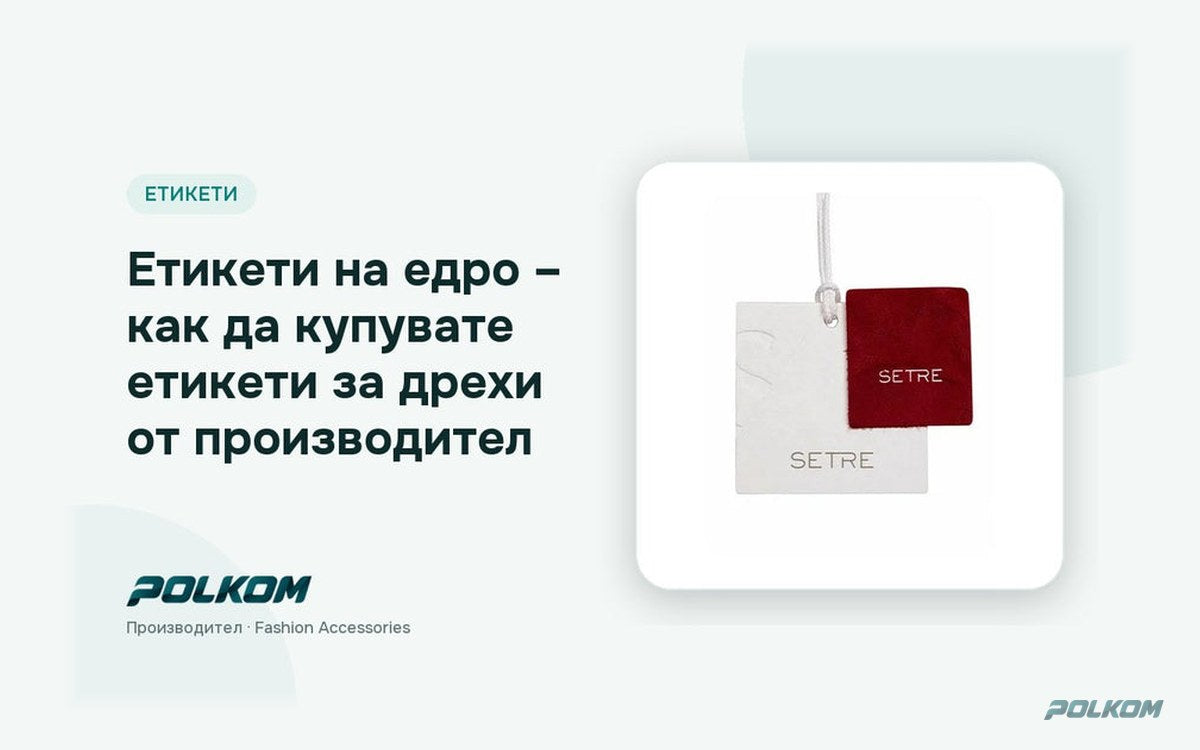
Wholesale labels are best bought directly from a manufacturer: you get labels to your design, a lower unit price on larger runs and the option of repeat orders with the same parameters. For garment factories, brands and distributors three things matter – the right run size, a sample before series production and planning deliveries together with the fabric and other trims.
Who buys labels wholesale
- Fashion brands – for brand labels, size labels, care labels and hang tags for each collection.
- CMT garment factories – for their clients' labels or their own neutral labels.
- Home textile manufacturers – bedding, towels, tablecloths, which also require care labels.
- Distributors and importers – for relabelling goods with local-language text.
- Manufacturers of bags, footwear and accessories – for leather and woven logo labels.
Stock or custom wholesale labels
There are two main purchasing models. Stock labels are ready-made neutral articles – for example size labels with generic markings or labels with generic symbols. Custom labels are made entirely to your design with logo, text and colours.
| Criterion | Stock labels | Custom labels |
|---|---|---|
| Design | Neutral, generic | To your logo and text |
| Availability | Fast, subject to stock | After sampling and production |
| Branding | None | Full |
| Suitable for | Factories, urgent needs | Brands and collections |
How to determine the run size
The run size is the most important decision when buying labels wholesale. Too small a run means a high unit price and frequent repeat set-up. Too large a run ties up money and carries the risk of leftovers if the design changes.
- Split labels by stability. The brand label rarely changes – it can be ordered in a large run. Care labels depend on the style – order them per article.
- Calculate by collection. Add up the pieces for all styles in the season and add a reserve for sewing rejects.
- Think about repeat orders. If sales go well, the next run can be larger with the same design.
- Ask about minimum quantities. They depend on the technology – for some label types the threshold is lower, for others higher.
Samples when buying wholesale
A sample is an essential step when ordering a new label. With large runs, a mistake in colour or spelling is multiplied by thousands of pieces. Check the sample on a real garment: sew it on, wash it according to the label and see how it behaves. Only then approve series production. For repeat orders with an approved design a new sample is usually not needed, unless the material or colours change.
What to check with the supplier
- A full range. One supplier for woven, printed, care, leather and cardboard labels saves coordination and guarantees a consistent style.
- Own production or trading. A manufacturer can adapt the design technically and control quality.
- Sampling speed. Important for brands working in seasons.
- Delivery. The option of delivery to your factory in Bulgaria or another EU country.
- Communication. A clear quote, written design approval and order traceability.
- Additional trims. If the same supplier offers buttons, zips and elastics, you can combine logistics.
Planning deliveries
Labels are often ordered last and then hold up sewing. Good practice is to include them in the collection schedule together with fabric and trims. Calculate the time for sampling, approval and production and leave a reserve. Care labels require the final fabric composition – get it from your fabric supplier in time.
For regular collections it is convenient to agree an ordering rhythm – for example the brand label is ordered once for several seasons, and care labels and hang tags for each collection. This way there is always stock of the main label, and the variable information is up to date.
Labels for relabelling imports
Distributors and importers bringing clothing in from outside the EU often need to add local-language text to existing labels. In this case printed labels are ordered wholesale with a translation of the composition, care symbols and importer details. They are sewn next to the original label. It is important that the translation uses the established fibre names and that the percentages match the original. If goods come from several suppliers with different compositions, prepare a list by article – this way each label matches the specific product exactly and there is no risk of incorrect labelling during an inspection.
Organising the order
With many articles, prepare a table with columns: style code, label type, text, sizes, quantity per size. The manufacturer can then pack the labels by article and size, and there is no confusion in the factory. This approach is especially useful for care and composition labels, where the text differs from style to style. For size and brand labels, see also our textile labels.
You will find all types in our clothing labels category.
Wholesale labels from the manufacturer – Polkom
Polkom is a Bulgarian manufacturer and wholesaler of sewing accessories from Sofia with over 30 years of experience and more than 10,000 articles. We produce custom labels with your logo, offer fast sampling, competitive prices and delivery throughout the EU, and alongside labels you can also order buttons, zips and other accessories. Send your article table via our contact page. Minimum quantities depend on the article – we will confirm them in the quote.