Manufacturer · Fashion & Home Accessories











Contents
Metal labels on workwear, uniforms and outdoor equipment work in completely different conditions from labels on fashion garments. They are washed at high temperatures, rub against equipment and are exposed to sweat, salt, rain and sun – and yet the logo has to stay clear for years. Polkom is a manufacturer of metal labels and logo plates and makes them in materials and finishes selected for the conditions in which the product will be worn.
What puts a metal label under strain
- Industrial laundering – high temperatures, strong detergents and long drum cycles.
- Sweat and moisture – the salts and acids in sweat attack the metal surface.
- Salt water – on marine uniforms, sailing wear and equipment, corrosion speeds up many times over.
- Abrasion – rubbing against belts, backpacks, seats and tools.
- UV radiation – on outdoor products, enamel and lacquers must keep their colour.
Materials for metal labels in harsh conditions
| Material | Character | Suitable for |
|---|---|---|
| Stainless steel AISI 316 | very high resistance, including in salt water | marine uniforms, sailing wear, equipment |
| Stainless steel AISI 304 | high resistance | workwear, uniforms, outdoor |
| Aluminium (anodised) | light, good resistance, high-contrast engraving | light jackets, backpacks, numbered labels |
| Brass with protective coating | classic look, high resistance when properly treated | uniforms with a formal look |
| Zinc alloy | raised relief and complex outlines | visible labels with a raised logo on bags and equipment |
All Polkom metal labels are nickel free – important for clothing worn all day. You will find more about materials for harsh conditions in the article accessories resistant to corrosion and salt water.
Stamped or cast labels
For workwear, stamped labels from stainless steel, aluminium or brass sheet are chosen most often – they are thin, light and economical for large runs. Cast labels in zinc alloy give deep relief and suit visible positions on bags, backpacks and equipment. There is a comparison of the two methods in the article cast or stamped metal plate.
Logo, numbers and series
On uniforms the label often carries not only the logo but also identification information. The options are:
- raised or recessed logo – made with a die, it does not wear off;
- laser engraving – for fine lines, small lettering and numbered series;
- enamel in a Pantone colour – for corporate colours visible from a distance;
- a combination – a raised logo and an engraved number on one label.
We explain how to choose the metal for engraving in the article metal plates for engraving.
Attachment that lasts
Rivets
The strongest attachment for thick materials, straps and backpacks. The label does not tear off and does not rotate. See rivets.
Prongs
The prongs pass through the fabric and are bent over on the inside; practical on jackets and trousers.
Sewing through holes
The most universal option for textiles. Use a strong synthetic thread and a reinforced seam.
There is a comparison of the methods in the article attaching a metal plate.
Finishes and colour for workwear
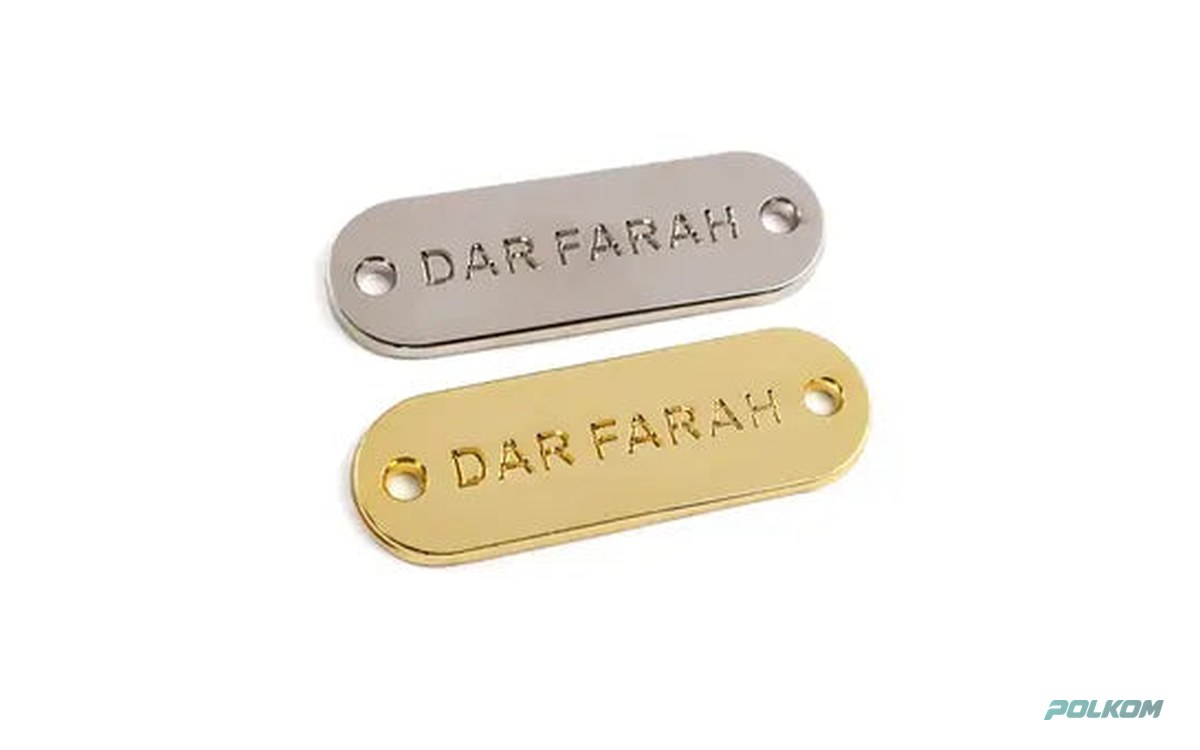
Stainless steel and aluminium can stay in their natural state – satin, polished or matt. Brass and zinc alloy are electroplated: nickel colour, gold, antique brass, gun metal or black. For workwear we recommend matt and satin surfaces that do not show scratches and fingerprints. If the label has to be in the corporate colour, the logo or the background is filled with Pantone enamel.
Common mistakes with metal labels for uniforms
- A label with sharp corners – it snags the fabric, straps and hands; choose a rounded outline.
- Sewing with ordinary thread – in industrial laundering the seam wears out before the label does.
- A logo that is too fine – thin lines fill up during plating; the line thickness must suit the size.
- A label heavier than the fabric – a solid cast label on a light shirt sags; choose a thin stamped label there.
Label size and position
On workwear the label sits on the chest, the pocket, the sleeve or the belt. Choose a size at which the logo can be read from several metres away, and a shape with rounded corners so it does not snag. You will find guide sizes by product in the article sizes of metal plates for clothing.
Metal label and textile label together
The metal label shows the brand, while the care information stays on the textile label inside the garment. For uniforms that are laundered industrially, see also the article labels for workwear and uniforms.
If the uniform also has metal buttons, eyelets or buckles, order them in the same finish – that way the whole outfit looks like one set.
How to order metal labels from Polkom
Send us your logo in vector format, the product, the wearing conditions (washing, salt, outdoor), and the material, size and attachment method you want. We make a sample for 50–100 €, and the production run is ready 10–20 days after approval. The minimum quantity is 1000 pcs per design. We deliver across Europe. Browse Polkom's metal plates.
Share this article